Mobile applications are the new norm in today’s hyper-digital economy, with millions of downloads per minute occurring throughout the year. In fact, in-app purchases have emerged as the most lucrative models available, covering both Android and Apple ecosystems.
Statistics show that global consumer spending on mobile apps reached $150 billion in 2024, and a substantial portion of this revenue came from mobile apps. This explains why businesses across industries are tapping into in-app purchase strategies to enhance user experience while driving recurring revenue.
Read on to discover 15 successful in-app purchases examples as we explain how they use IAPs to create sustainable income, and what lessons are in it for your business.
What Are In-App Purchases (IAPs)? Let’s Start With The Definition
Before we explore real-world in-app purchase examples, it’s crucial to understand what In-App Purchases (IAP) are. In simple terms, an in-app purchase refers to a wide range of digital transactions that allow users to access additional features, premium content, or services within a mobile app at a given cost. It represents the freemium model, where the app is free to download initially, but further upgrades are monetised.
IAPs are divided into several distinct categories.
- Consumable purchases (e.g., gaming coins, virtual tokens)
- Non-consumable purchases (e.g., ad removal, permanent premium unlocks)
- Auto-renewable subscriptions (e.g., monthly or yearly access to exclusive features)
- Non-renewable subscriptions (e.g., short-term premium access)
Understanding the different categories of in-app purchases is crucial if you are looking for money-making app ideas or if you are looking to exploit your own in-app purchases business model.
Now, let’s explore the best app ideas that changed the world with their iconic brand marketing and application services.
1. Candy Crush Saga – Iconic Childhood In-App Purchase Example
Candy Crush is hands down one of the most popular mobile gaming apps that serves as one of the best in-app purchase Android app examples. Having become a phenomenon in the gaming world, the game boasts 2.7 billion downloads and a remarkable revenue milestone of $1.2 billion.
Backed by a devoted fan following, its influence has multiplied over time, resulting in a series of engaging spin-offs, including Friends Saga, Jelly Saga, and Soda Saga. While the standard version of the game is accessible to all, players can pay an additional amount to gain extra moves, boosters, and power-ups to advance to higher levels faster.
Players can still progress without having to pay anything, but these small purchases can take the gaming experience to a whole new level. The game’s key differentiator lies in creating a sense of urgency and offering reward loops that make optional purchases feel like valuable shortcuts.

2. Medium – The Best Example Of In-App Purchases
Medium, with no doubt, is a great example of how in-app purchases can successfully power a content platform. While the Medium’s application itself is free to download and use. But Medium has a subscription-based IAP model where users can unlock premium features such as unlimited article access, exclusive stories, and an ad-free reading experience through monthly or annual in-app purchases.
This model shows how apps can monetise by offering added value rather than restricting basic functionality. By blending free access with optional upgrades, Medium demonstrates how in-app purchases can create a sustainable revenue stream while still keeping the core experience accessible to everyone.

3. Duolingo – IAP to Print Revenue Behind Genius Marketing
The most well-known and favourite application among language learners, Duolingo, also targets users who want to become fluent in any language. Duolingo converts approximately 6-8% of free users to premium subscribers.
Besides great marketing strategies, Duolingo also has some outstanding features in the app itself. Its subscription package aims to offer an ad-free experience, unlimited chances to learn without incurring a penalty, and progress tracking features for passionate learners.
What makes it a perfect contender among perfect in-app purchase examples is the way it uses positive reinforcement to convert a free user base into paying customers.
With the best psychological business tactics, of course, they didn’t stop at just psychological marketing—they also use smart tactics to improve their unique application features. One of these is upselling their subscription not only after every completed lesson but also in the navigation bar, in the shop, and after reviewing hearts. So, if your app belongs to a similar niche, a solid strategy is to blend gamification with smart paywalls.

4. Elsa Speak – It’s Time to Scale with AI App Ideas
Another strong lifestyle/education app that uses in-app purchases effectively to deliver premium value… but with AI!
Elsa Speak is a cross-platform application with a core highlight that is its AI-driven speech analysis. This helps users improve their English pronunciation with free access to basic lessons, while advanced features are reserved for paid subscribers.
Through in-app purchases, users can unlock ELSA Pro. It includes full lesson libraries, personalised learning paths, detailed pronunciation scoring, and progress analytics.
This freemium model works well because learners experience real improvements with free features, making the paid upgrade feel like a natural next step. This AI-based application demonstrates how educational and lifestyle apps can use IAPs to provide deeper, more personalised learning experiences while generating steady, recurring revenue.

5. Calm Application – Best In-App Purchase Example for Meditation Enthusiasts
Calm, the meditation and sleep app, has built its success on in-app subscriptions that allow users to unlock a range of premium features like guided meditations, bedtime stories, and music.
Thanks to in-app purchases, Calm’s revenue rose to approximately eight million U.S. dollars in 2025, making it the leading app in the health sector.
By drawing a clear divide between free and premium content, the app appeals to users with mental health concerns and sleeping difficulties while adding to its perceived value. In a niche as competitive as Health and lifestyle, Calm has not only survived but also stood out on its own by linking emotional well-being with consistent content updates.

6. Apple Books – Apple’s Users’ Most Beloved IAP Application
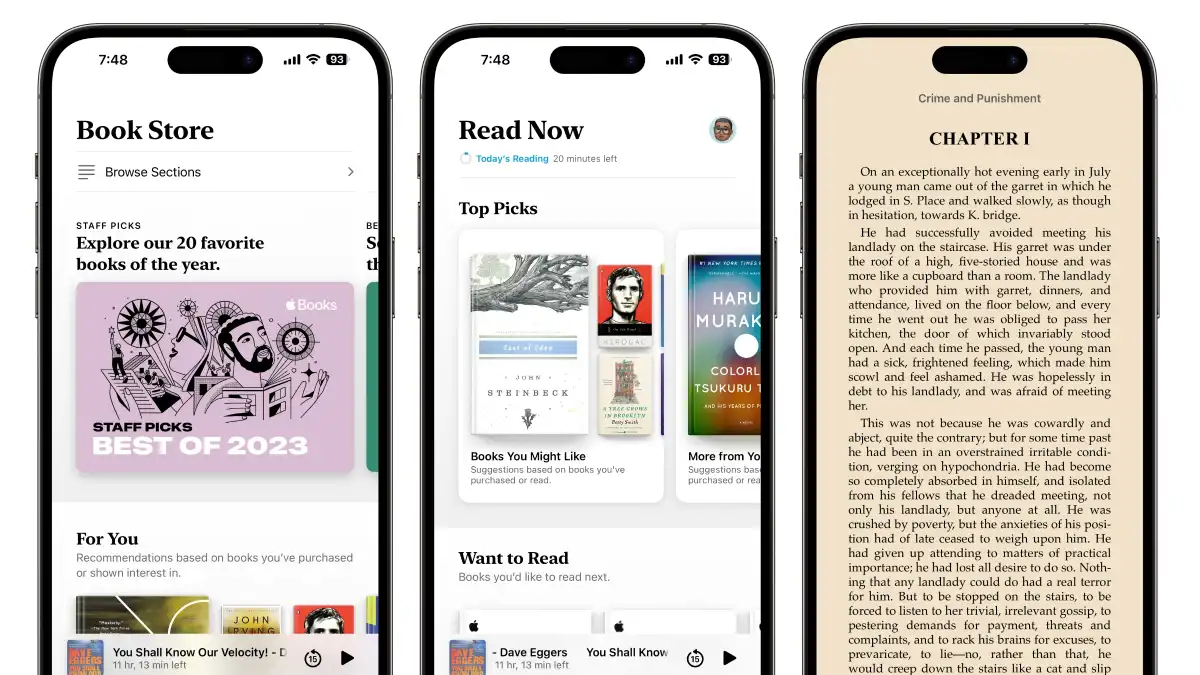
This application needs no introduction! But in case you don’t know: Apple Books lets you buy and read eBooks, as well as listen to audiobooks. Users can browse and discover new and best-selling titles, create a personal library to organise their purchases, and track their reading habits with features like Reading Goals. The app replaced the old iBooks app and also allows sharing purchases with family members. So, if you’re an iOS application lover, this is a must-try.
Apple Books is a strong example of how in-app purchases can be harnessed in the digital marketplace. Although the app is free to use, readers can buy individual ebooks, audiobooks, and premium series directly within the app through simple, frictionless in-app purchases.
This model shows how apps can monetise by offering a vast library of paid content while still allowing users to browse, preview, and enjoy free samples at no cost.
7. Spotify – Application Business with Music
Spotify Premium has changed the application business industry with explosive growth, with up to 276 million subscribers as of Q2 2025. Out of €13.25 billion in total annual revenue, 87.32% came from Premium Subscriptions, while the rest came from Ad-Supported Business.
This underscores Spotify’s success in leveraging free and paid user experiences in its monetisation strategy. This means that while users can stream their favourite music for free, they can pay to download songs, listen to them online, or go ad-free for an uninterrupted listening experience.
The app zeroes in on a common user concern- the influx of ads while listening, and thus draws in users to upgrade to premium to get rid of ads. By doing this, it teaches us that the best upsell can come from simply removing friction from the user experience.

8. Headspace – Best IAP App Idea for Doctors and Healthcare
Headspace has distinguished itself in the wellness realm through its subscription model that presents the strongest in-app purchase examples. The app continuously incorporates updates that involve new guided meditations and programs for wellness-conscious users who wish to keep the momentum going in their wellness journey.
This gives them a valid and strong reason to go for renewals while sustaining user engagement, which promotes retention and paves the way for recurring in-app revenue.

9. My Fitness Pal – App Idea for Fitness Coaches and Dietitians
So far, the most reliable examples of successful applications are in the lifestyle category. While the app offers free calorie tracking and basic features, users can upgrade to a Premium subscription through an in-app purchase to unlock deeper insights, advanced meal planning tools, custom macronutrient goals, barcode scanning features, and ad-free usage.
It’s a classic example of the freemium-to-premium model in lifestyle apps, proving that offering essential tools for free while reserving powerful features for paying users can drive strong recurring revenue.

10. Evernote – Productivity App Idea
A recognised productivity app, Evernote, allows users to make notes of everything important, keep track of their schedule, and organise their tasks all in one place. Its in-app purchases come with features not accessible in the free plan, including offline access, device syncing, and advanced search features. USP can be boiled down to 2 key factors, both of which are highly valuable for Productivity users: time and efficiency — both of which are monetised effectively.
If your app actually saves users time or improves workflow, monetisation feels a natural part of your business strategy, not forced!

11. Pokémon GO – Gaming App Idea with Childhood Play
The success of Pokémon GO’s purchases is deeply tied to the tangible, real-world actions required to play the game. The game requires players to walk, explore, and visit physical locations (PokéStops and Gyms), and having in-game consumable items can help them reach their destinations comparatively easily.
These accessories can only be accessed via PokéCoins, and therefore, serious game users feel compelled to resort to consumable IAPs like PokéCoins to enhance gameplay and fast-track their progress.
Augmented reality and the ability to explore real-world features enhance the commercial appeal of the game, so that users come to perceive purchases as purposeful and rewarding.

12. Netflix – Best MVP Application That’s Making Billions
Started with just an MVP application of their product, Netflix had already proven it’s not hard to scale when your application is just in an MVP phase. Netflix’s success as a prominent in-app purchase Android example by providing affordable and top-quality entertainment for different user groups. Its primary purpose is to make subscription stress-free and super-convenient, and integrating with platform-specific in-app purchases (IAPs) is an integral part of that strategy.
By linking a Netflix subscription with an IAP, it aims to tap into iOS users who can easily have their payment method linked with Apple. This one-click advantage not only allows capturing user interest in instant viewing but also gives it easy access to users across iOS platforms.

Key Takeaways from These 12 In-App Purchase Examples
After analysing these leading in-app purchases examples, we can glean a few trends that define success in in-app purchase business models:
1. Freemium is King When It Comes To Application Business
When it comes to application development and business, free features work like magic in getting users to subscribe initially and then upgrade once they are certain to receive additional benefits with valuable paid add-ons, against pay-to-download apps.
2. Emotion and Connections Drive Conversion
Apps are not just related to specific functions but are intrinsically connected with some human emotion. An app can emotionally connect with users through various ways, like creativity, competition, or maximising comfort, which magnifies the prospects of customers converting to paid features to derive greater satisfaction.
3. Tiered Pricing Works
Offering multiple tiers is a business-savvy approach as it enables an app to break barriers and adopt an inclusive approach in reaching out to a wider user base.
This not only strengthens the app’s competitive potential, but each new user contributes to the revenue stream.
4. Retention Over Acquisition
On the surface, acquiring new users seems to be the ultimate measure of an app’s success. In reality, an app’s long-term value depends on its potential for long-term engagement and ability to deliver continuous updates rather than just quickly convert to in-app purchases.
5. Ethical Monetisation Wins
Apps that respect and prioritise user experience in any way, e.g., non-intrusive ads or optional upgrades, are well-positioned to sustain their users and foster commitment to yield sustained profits.
Conclusion of In-App Purchase Examples
These 12 in-app purchase examples prove that the right application marketing strategy can turn your app into a sustainable, long-term business asset.
The key lesson? When planning your next app, your ultimate goal should be to pass value to users that they willingly pay for and keep coming back to.
Whether you’re refining an existing app or building a new one from the ground up, Crossway Consulting’s mobile app development services help you design user-centric, conversion-focused IAP systems that support real business growth. Let’s develop an app that delivers value for your users and your bottom line.
FAQ
1. What are the different types of IAP?
There are four main types of in-app purchases (IAPs): consumable IAPs, non-consumable IAPs, auto-renewable subscriptions, and non-renewable subscriptions. Consumable IAPs refer to items that can be used up and repurchased, e.g., gaming coins, extra lives, and tokens. Non-consumable IAPs are one-time unlocks to permanent features like removing ads or getting a filter.
2. What are considered in-app purchases?
An in-app purchase is any digital transaction made by a user from within a mobile application for a specific purpose, like unlocking features, purchasing subscriptions, removing ads, or gaining access to premium content. Anything you pay for inside an app is considered an in-app purchase.
3. What are the examples of in-game purchases?
In-game in-app purchases are usually made through a gaming app like Candy Crush Saga, PUBG Mobile secure certain advantages and help with game progress. Some common examples include:
- Virtual currency (coins, diamonds, gems) and Time accelerators (e.g., speeding up building or upgrades)
- Extra lives or health boosts
- Weapon skins, outfits, and character customisations
- Battle passes or seasonal passes.