

Customer support is where subscription businesses either earn renewals or lose them. We build custom SaaS customer support platforms — help desks, omnichannel ticketing, AI-assisted support, and self-service tools — designed around how your support team actually works, not a generic template.
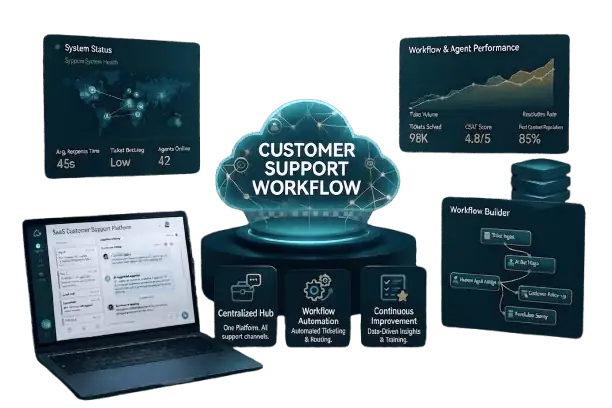
Great customer support software isn’t about adding every feature — it’s about making the workflow your support team already runs faster, clearer, and less repetitive.
Before we build anything, we look at where your current support process actually breaks down.
Custom ticketing built around your team’s actual triage and escalation process, not a rigid default workflow.
Support performance reporting built around the metrics that actually predict retention.
AI applied where it actually reduces agent workload — triage, drafting, and self-service — not a chatbot bolted on for its own sake.
Fast, low-friction support paths for customers who’d rather solve something themselves than wait for a reply.
Searchable documentation and community spaces that deflect repetitive tickets before they’re ever opened.
Support performance reporting built around the metrics that actually predict retention.
We start with how your support team really works today, not a generic ticketing template.
Automation and chatbots get built where they genuinely reduce agent workload, not because every support tool claims AI today.
Dashboards and reporting built around the KPIs that actually correlate with retention, not vanity metrics.
Your support platform connects to your CRM, product data, and existing tools instead of operating in isolation.
We stay involved after launch, iterating based on real ticket and support-outcome data.
The platform we build is shaped around the metrics that actually indicate whether your support is working — not features for their own sake.
Direct customer feedback on individual support interactions.
How quickly a customer gets an initial reply.
How often an issue is resolved without a follow-up.
How long it takes to fully close out a ticket.
Whether support quality is showing up in renewal behavior.
Helpdesk, ticketing, and support platforms built for fast response and clear escalation paths.
Order, returns, and account support built around real transaction volume.
Support tooling for legal-tech platforms where accuracy and documentation matter.
Support systems for finance and accounting platforms handling sensitive data.
If your team already uses an existing help desk or ticketing tool, we can build custom integrations and extensions around it rather than requiring a full replacement — the right approach depends on what your current setup is missing.
We map your current support process, channels, and pain points before proposing a solution.
Ticket routing logic, channel architecture, and agent-facing UI designed around your real workflow.
Sprint-based build of the ticketing, chat, and knowledge base systems your team needs.
AI-assisted features and CRM/product-data integrations layered in where they add real value.
Functional and load testing, followed by a managed rollout to your support team.
Ongoing iteration based on real ticket volume, CSAT trends, and agent feedback.
A single-channel help desk vs. a full omnichannel platform.
Basic ticket routing vs. AI-drafted replies, chatbots, and predictive triage.
Number of CRM, product-data, and third-party tools that need to connect.
Support systems for a small team look different from ones built for large, multi-tier support orgs.
A simple FAQ page vs. a full knowledge base and community forum system.
We give a project-specific estimate after a discovery conversation grounded in your actual requirements — not a generic range that doesn’t reflect the build.
Our full SaaS development offering, from MVP to enterprise platforms.
View SaaS Development →CRM, campaign management, and pipeline tools built around how your sales and marketing teams actually work.
View Marketing & Sales SaaS →Multi-tenant storefront, inventory, and order management platforms built to handle real transaction volume.
View eCommerce SaaS →Banking, lending, and payments platforms built with the security and compliance the category demands.
View FinTech Development →Payroll, onboarding, and workforce management platforms built for multi-location, multi-tenant teams.
View Cloud HR Software →
SaaS customer support is the set of tools, workflows, and systems a software business uses to help its users — ticketing, live chat, knowledge bases, and increasingly AI-assisted support — usually delivered through the same cloud-based, always-on model as the product itself.
In a subscription business, support directly affects renewal. A slow or frustrating support experience gives customers a reason to churn at their next renewal date, while fast, effective support builds the trust that keeps a subscription relationship going year over year.
Common levers include reducing first response time, adding self-service options for common issues, routing tickets to the right team faster, and using customer data to give support agents context before they respond. Which levers matter most depends on where your current support system is actually falling short.
Common metrics include Customer Satisfaction Score (CSAT), first response time, first contact resolution rate, average resolution time, and churn or retention rate. No single metric tells the whole story, so most support teams track a small set together.
The most common are CSAT (customer satisfaction score), first response time, first contact resolution (FCR), average resolution time, ticket volume and handling capacity, and customer churn or retention rate.
Omnichannel support means a customer can reach you through email, live chat, phone, or social media and have those interactions unified in one system, so an agent has full context regardless of which channel the customer used, and the customer doesn't have to repeat themselves.
AI can triage and route incoming tickets, power chatbots and self-service for common questions, summarize long ticket threads for agents, and surface relevant knowledge base articles automatically. The goal is to handle routine volume faster so human agents spend their time on the cases that actually need judgment.
First contact resolution (FCR) measures how often a customer's issue is fully resolved in their first interaction, without needing a follow-up. Higher FCR generally correlates with higher customer satisfaction and lower support costs.
Support software should make your team faster and your customers more confident — not add another system nobody fully adopts.