The SEO landscape has rapidly evolved over the last few years, but AI has led to a major overhaul that has challenged the very fundamentals of SEO. A shift is underway in how search works as Google AI Overviews, Perplexity, and ChatGPT change the rules of the SEO game.
The latest data shows that 60% of Google searches end without a click, a trend known as zero-click searches. These searches now fall in the domain of AEO, where AI search engines synthesize the most relevant answers directly in response to a search query without having to click a site from search results.
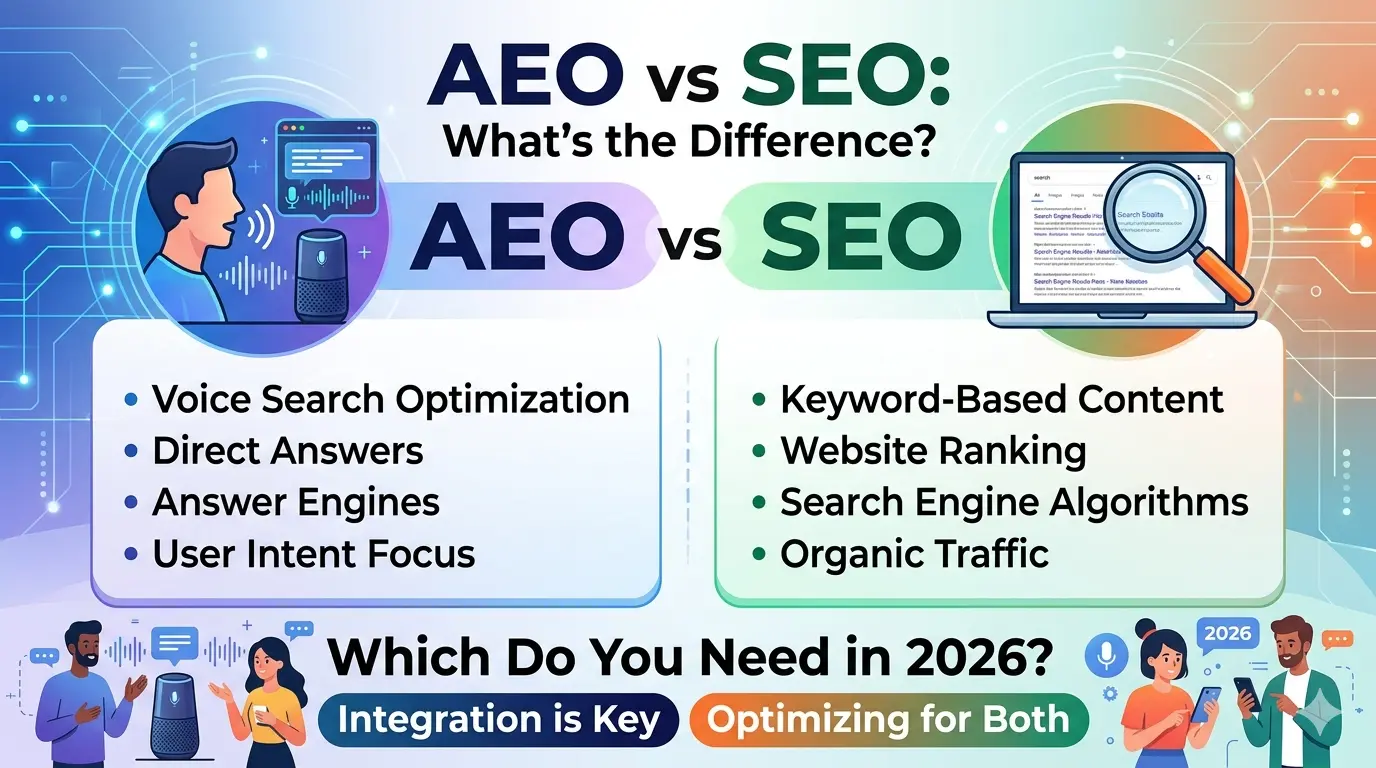
In this guide, we’ll break down AEO vs SEO, explain how each works, and help you decide where to focus in 2026.
What is traditional SEO?
Search engine optimization refers to the techniques and tactics followed to improve a website’s visibility in organic search engine results pages (SERPs). The core idea behind SEO is to optimize a website to make it rank higher on search engines like Google and Bing and thus drive maximum traffic to your site.
Traditional SEO works across three interconnected layers:
Technical SEO
Even a site with the best content can’t possibly rank if it’s technically broken or flawed. This SEO handles the technical aspects of your website’s architecture to make it easy for search engine crawlers to access, understand, and index your site efficiently. This includes elements such as page speed, Core Web Vitals, mobile responsiveness, and structured URL architecture to enhance the user experience.
On-page SEO
This entails optimising the content itself primarily through incorporating relevant keywords that match the search intent of your target audience. Other important on-page SEO elements include structuring content for headings and creating helpful, people-first content aligned with Google’s E-E-A-T framework to rank higher in search results.
Off-page SEO
This involves boosting a site’s authority across the web by gaining a sufficient number of backlinks from reputable, relevant sites. A well-maintained backlink profile remains the most significant off-page ranking factor alongside brand mentions, reviews, and citations.
What Is Answer Engine Optimization (AEO)?
Answer engine optimization is the practice of structuring and optimizing your content so that it is cited directly in AI-powered answer engines.
While SEO focuses on positioning your content for Google’s Google’s ranking algorithm to appear in a list of results, AEO targets the AI systems that bring together insights from multiple top pages into a single answer at the top of the page.
The “answer engines” you’re optimising for include:
- Google AI Overviews (formerly Search Generative Experience): These are AI-generated summaries that occupy a major share of informational queries and
- ChatGPT and GPT-4o: An AI tool used by millions of people for research and other creative and technical tasks.
- Perplexity: An AI-native search engine that cites sources online and is well-known for its capability to conduct broad-based searches across the web.
- Voice assistants: Includes Siri, Google Assistant, and Alexa, which pull from structured data and featured snippets to answer verbal queries.
These systems replace user discretion and let AI select the best content aligned with a search query and deliver it straight to the user. This way, the user doesn’t have to scramble their way through multiple links and instead gets what they are looking for.
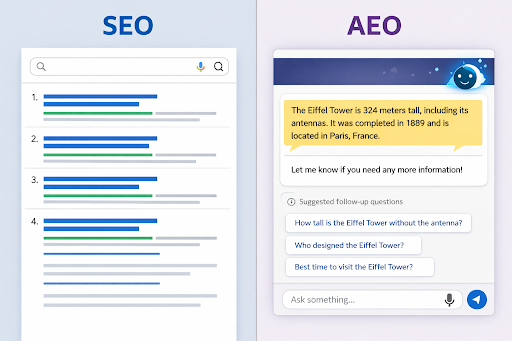
AEO vs SEO: side-by-side comparison
| Factor | Traditional SEO | AEO |
| Primary goal | Rank in blue-link search results | Get cited in AI-generated answers |
| Target platforms | Google, Bing | Google AI Overviews, ChatGPT, Perplexity, voice assistants |
| Success metric | Ranking position, organic traffic | AI citation frequency, brand mentions in AI answers |
| Content format | Long-form, keyword-optimised pages | Question-and-answer structure, direct and extractable |
| Technical requirements | Core Web Vitals, crawlability, and site architecture | Schema markup, structured data, entity optimisation |
| Authority signals | Backlinks, domain authority | E-E-A-T, knowledge graph presence, citation patterns |
| Timeline to results | 3–6 months typically | 4–12 weeks for initial AI citation signals |
| Traffic impact | Direct — click-throughs from ranked results | Indirect — brand visibility without clicks |
Neither of the emerges as an all-out winner as each serves distinct but complementary goals. SEO has evolved substantially since its early origins, when it was simply a matter of placing keywords and expanding your linking network. Modern SEO has become much more sophisticated as Google’s algorithms now assess websites across a range of parameters like topical authority, content depth, and user experience.
The key goal remains the same, which is to get your content to rank in the first ten blue links. What has changed is that brands are now competing against AI-generated answers that comprise a growing share of total searches.
Key Technologies Behind AEO
These systems prioritize clarity, credibility, and structure over keyword density.
E-E-A-T (Experience, Expertise, Authority, Trust)
When it comes to SEO, the content guidelines favor well-optimized, detailed content like blogs, articles, and webinars. In contrast, AEO is grounded in language models that prefer clear, to-the-point answers that demonstrate genuine expertise and experience to offer unique insights to users.
Schema markup
This refers to structured data code embedded in a website’s HTML that allows search engines to understand the context behind content, products, or local businesses, resulting in descriptive snippets, increased visibility, and higher click-through rates.
Voice search
The fact that over a billion voice searches are performed every month speaks to their growing importance in online searches. The rise of Smart device voice assistants has radically transformed search behavior, with more users turning to natural, conversational voice commands.
AI-generated summaries
These include featured snippets, short excerpts at the top of Google search results pages, and people also ask sections. These include a set of related questions and clear, concise, and conversational answers. Optimizing for both entails creating readable content, adding an FAQ section, and using question-based headlines to increase your chances of being cited by AI-generated summaries and answer engines.
SEO optimises for click-through while aiming for higher rankings and ultimately traffic. AEO optimises for citation. Your brand’s visibility in AEO is proportional to how often it is favored in AI-generated answers, as this translates into increased brand awareness, and eventually, more users navigate directly to your site.
When to Use AEO vs SEO
The most common misconception about AEO is that it is replacing SEO. This is far from true, as they address different surfaces of the same search landscape while relying on inputs that reinforce one another.
Prioritise SEO first if
Your business relies primarily on transactional searches where users click through to compare options, make purchases, or contact a provider.
A user searching “plumber near me” or “buy running shoes online” is already in the buying stage and is highly likely to click on a site that will best satisfy their need.
AI Overviews are typically designed to cover queries with informational intent, while traditional SEO drives these conversions.
Prioritise AEO first if:
You intend to make your brand discoverable for your target audience. This includes businesses that predominantly rely on information-based queries, such as “how does X work”, “what is the best Y for Z”, and “explain [topic]”. Professional services, agencies, B2B companies, and knowledge-intensive businesses form part of this category.
AEO can act as an amplifier for your digital presence, making you the top source for citations in AI overviews, voice search results, and even chatbot responses. This, in turn, will expand your reach to a degree not possible in traditional searches.
Invest equally if:
Your audience moves through an informational journey before making a transactional decision. This describes how the majority of B2B buying processes pan out, and how consumers now purchase
AI forms the starting point of their research, followed by clicking through to evaluate a list of potential providers before making the actual purchase.
You need to feature in the AI answer (AEO) and the search results compiled by AI search engines to stand out in an age of AI-driven search. Today, visibility isn’t limited to blue links, but making your content the top answer for hyper-specific, high-intent customer queries.
Do You Still Need SEO in 2026?
The honest answer is: almost certainly yes. Both are not mutually exclusive and can work as interrelated parts of your digital strategy based on your business type and evolving user behavior.
In 2026, relying wholly and solely on traditional organic traffic is a sure-shot way to render yourself invisible to AI overviews. The fact that your audience sees AI answers whenever they type in a search query means that you are missing out on a substantial opportunity to capture a user base beyond clicks.
No wonder many local service providers and B2B SMBs are grappling with the challenge of AI-driven SERP features that have drastically reduced their potential to engage with audiences as in the past.
As the battle of visibility wages on in the AI era, it’s no longer about securing the top spot in search engine results pages or drawing the maximum number of clicks
Frequently asked questions
What does AEO stand for?
AEO stands for answer engine optimization. It is the process of creating and structuring content for AI-powered answer engines, including Google AI Overviews, ChatGPT, Perplexity, and voice assistants, which cite it directly in their responses. Unlike SEO, which targets higher rankings, AEO improves online visibility by placing your brand on top of traditional search results and delivering clear, precise answers to informational queries.
How quickly does AEO produce results?
AEO can produce results in 4–12 weeks, much faster than traditional SEO, as long as your content is well-structured and targets low-competition topics. Getting your brand cited in AI overviews or AI search engines involves less competition than traditional search engines like Google and Bing. However, sustained efforts are required to ensure your content gets cited frequently across multiple AI platforms, similar to long-term optimization for SEO.
Is AEO replacing SEO?
No. AEO is extending the boundaries of traditional SEO by adding a layer of AI in the search landscape. While SEO is all about gaining organic traffiC, AEO leverages zero-based clicks where the goal is to get your tank featured in AI-generated answers. In 2026, both are necessary as they share the same content and technical foundations, although they have different parameters for measuring success.
What is the role of schema markup in AEO?
Schema markup is structured data added to your website’s code that tells AI systems and search engines exactly what your content means. FAQPage schema, HowTo schema, and Article schema make content significantly more parseable by AI models, improving the likelihood of extraction and citation.
How does AEO work?
AEO works by structuring content using clear answers, entities, and structured data so AI-powered systems can easily extract and present it as an answer to specific search queries. This ensures your brand is cited in zero-click searches, such as in AI overviews, featured snippets, and AI search engines like Perplexity and ChatGPT that favor clear, concise answers.