By SEO Strategist & Digital Marketing Consultant At Crossway Consulting
Updated: May 2026 | 14-minute read
In 2026, choosing an SEO package is more confusing than ever. Agencies promise rankings, AI-powered optimization, and rapid traffic growth — yet many businesses still waste thousands on SEO campaigns that never generate leads or revenue.
With numerous agencies in the market, the real challenge is to find a dedicated SEO partner that can deliver consistent results and help you scale over time.
In this guide, we provide a jargon-free way for business owners, marketing managers, and entrepreneurs to understand everything about SEO packages to help them succeed.
We cover what does SEO include , how SEO pricing plans work, what red flags to avoid, and how to match a package to your specific business situation.
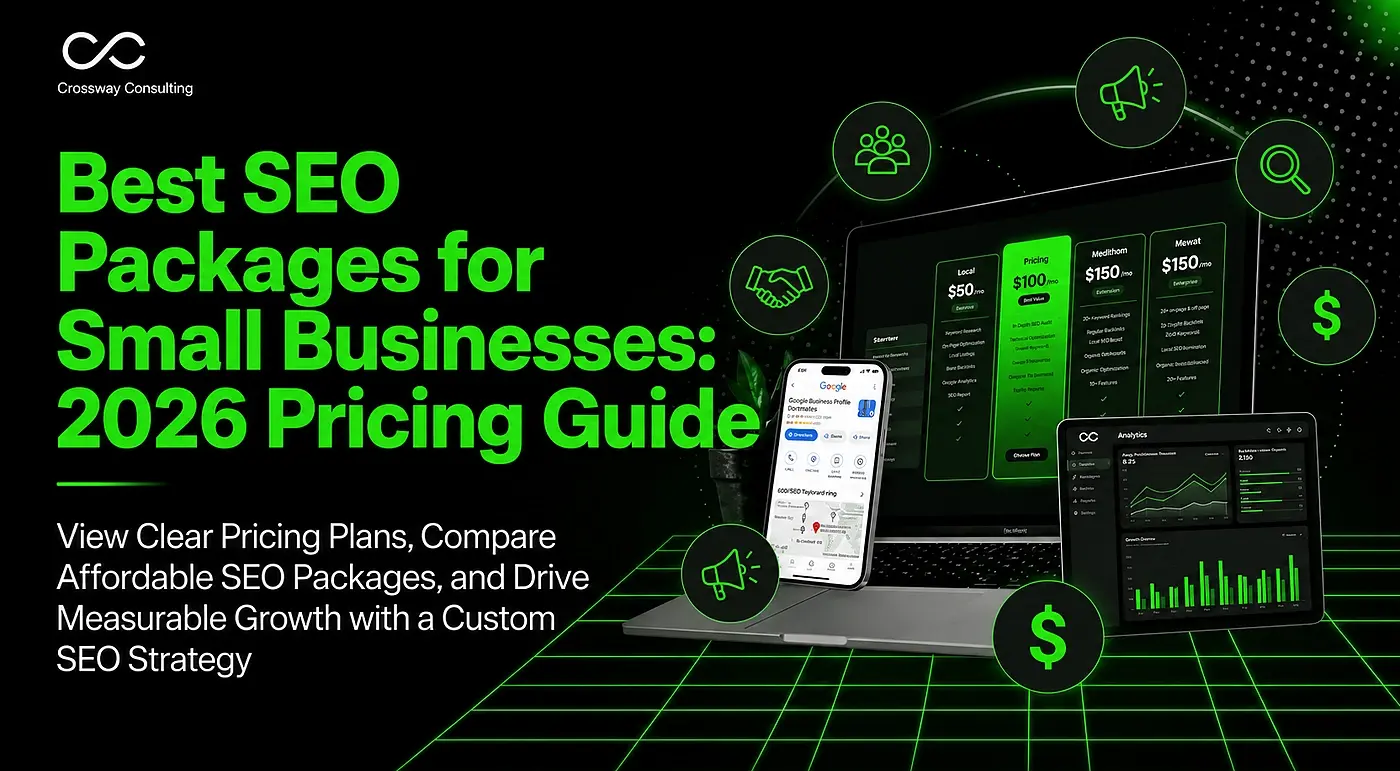
| The best SEO service packages in 2026 combine technical SEO, on-page optimization, local SEO, content strategy, link building, and reporting in one clear plan. The right package depends on your competition, your growth stage, and how quickly you need results. |
What Does SEO Include in 2026?
Before you start comparing packages, you need to be clear about what the top SEO packages offer. SEO is an umbrella term that comprises various aspects of optimizing your online presence, like technical accuracy, local visibility, and leads, etc., to drive measurable growth.
Here’s what a comprehensive, modern SEO engagement should cover:
1. Technical SEO
Technical SEO services are the foundation of every successful SEO campaign, helping search engines find, crawl, and understand what your website is about. If your technical architecture is not right, you cannot expect to rank high, no matter how rigorously you implement on-page and off-page SEO.
In 2026, a technical SEO audit is an integral part of a modern SEO package that tackles multiple technical issues like crawling errors, broken links, mobile-friendliness, duplicate content, and more.
The key components of a technical audit include:
- Core Web Vitals optimization: Google’s page experience signals (LCP, INP, CLS) directly affect rankings
- Site architecture and crawl efficiency: This ensures Googlebot doesn’t waste its crawl budget on unimportant pages
- Schema markup / structured data: Helping your pages appear more prominently in search results
- Mobile-first indexing compliance: Google indexes the mobile version of your site first; any discrepancies hurt rankings
- Indexing health: Tracking which pages are indexed, which are blocked, and fixing orphaned pages
- Internal linking strategy: Distributing page authority across your site intentionally
Technical SEO cannot be treated as optional or as an add-on, as it helps structure your site to deliver a fast, secure user experience.
2. Local SEO
Businesses serving a specific geographic area rely heavily on local SEO, such as a dentist, a law firm, a restaurant, or a contractor, to stay ahead in local searches.
Local SEO packages typically include:
- Google Business Profile (GBP) optimization: Setting up an optimized GMB profile is key to appearing at the top of search results.
- Local keyword targeting: Local SEO targets common search queries, “emergency plumber [city]” vs. just “plumber,” to reach out to your target audience.
- Citation building and cleanup: Maintaining consistent NAP across Yelp, Apple Maps, Bing Places, and other directories reinforces your local presence.
- Review strategy: Generating and responding to reviews boosts your site’s credibility and conveys strong ranking signals.
- Location page optimization: If your business is spread across locations, your location pages should be optimized
- Local link acquisition: Acquiring mentions from local news outlets, chambers of commerce, and community organizations.
3. On-Page Optimization
On-page SEO is the process of optimizing a website’s content and HTML source code to make it relevant and readable for both humans and search engines.
This covers a range of elements like:
- Title tags and meta descriptions (still critical for click-through rate)
- Header hierarchy (H1–H4 structure)
- Keyword placement and semantic relevance
- Image alt text and file optimization
- Content depth and topical coverage
- URL structure and slug optimization
- Internal linking from and to each page
A key aspect of modern on-page SEO is entity optimization, which ensures Google understands who and what your content is about, not just which keywords it contains.
4. Link Building and Digital PR
Backlinks remain one of Google’s top ranking factors. However, it isn’t so much about the quantity of links as the quality and relevance of links that add to your domain authority and signal trust to search engines.
Legitimate link building in 2026 includes a range of white-hat tactics like:
- Editorial outreach: This includes contributing high-quality content on relevant, authoritative sites in your niche to build authority and referral traffic.
- Digital PR: Creating original, research-based content that is cite-worthy for mentions in news outlets, industry blogs, and trade publications.
- Resource link building: Creating genuinely useful tools, guides, or data studies that serve as linkable assets to attract links organically.
- Local citations: For local SEO, maintaining consistent NAP data (Name, Address, Phone) across directories is critical
Beware of agencies that exploit spammy tactics to create a network of backlinks that are counterproductive to your site’s growth. A good way to judge link-building services is to include key metrics such as the domain rating of acquired links and the subsequent impact on rankings for those pages.
5. Content Strategy and Creation
In 2026, a viable content strategy goes beyond isolated blog posts and instead focuses on building topic cluster models, in which related subtopic pages support a single pillar page. Any outdated content should be updated to ensure content freshness and relevance.
Keyword research forms the basis of a content strategy that involves selecting specific search queries and phrases that your target audience is likely to use when searching for your services or products. Any agency can commit to a set number of ready-to-publish and SEO-optimized content assets as part of the SEO package, including blog posts, articles, landing pages, guides, etc.
They generally provide a content calendar that details when the content is likely to go live, the platform where it will be posted, and the subject matter. This helps establish a consistent content schedule to ensure content is aligned with your broader business goals.
High-quality, user-centric content can help you rank higher for your target terms and draw more organic traffic to your site. Without strong content, even technically optimized sites struggle to build authority, thus affecting their ranking potential.
6. Reporting and Analytics
Finally, Reporting and Analytics is another essential component that demonstrates the true value of an SEO package. They typically include clear dashboards, keyword tracking, and ROI metrics to tie SEO activity to tangible business outcomes.
A quality package includes:
- Traffic KPIs: Organic sessions, users, and pageviews.
- Ranking KPIs: Keyword ranking changes for a core set of target terms.
- Engagement KPIs: Bounce rate, time on page, and pages per session.
- Conversion KPIs: Organic goal completions (e.g., leads, sales) and conversion rate.
If a provider lacks a clear reporting framework, that’s a sign of weak accountability and poor transparency.
Seo Agency Pricing: What Should You Expect to Pay?
Cost is a decisive factor when it comes to SEO packages, but it is also the most confusing. This is because SEO pricing varies wildly based on provider quality, scope of work, market competition, and business size.
Pricing Model 1: Monthly Retainer
This is the standard pricing model for ongoing SEO services that requires you to pay a fixed monthly fee for a defined set of deliverables. Monthly SEO packages is typically divided into various tiers based on your growth stage and your SEO goals.
Here’s a breakdown of the average monthly costs for different tiers and who they serve best:
Package Tier |
Typical Monthly Cost |
Best For |
| Starter / Local | $300 – $800 | Small local businesses, new websites |
| Growth / SMB | $800 – $2,500 | Competitive local markets, regional businesses |
| Professional | $2,500 – $5,000 | National competition, e-commerce, lead gen |
| Enterprise | $5,000 – $15,000+ | Multi-location, highly competitive industries |
The pricing of these tiers varies according to factors like;
- Number of target keywords and pages
- Amount of monthly content production
- Link building volume and quality
- Technical complexity of the site
- Industry competitiveness (legal, finance, healthcare, and real estate are the most expensive niches to rank in)
- Whether the agency is a boutique, mid-size firm, or a large agency
Pricing Model 2: Project-Based
This model works best when you have a pre-determined scope in mind for engaging services, such as a full technical audit, keyword research, link-building campaign. These packages apply for a finite period and typically have a clear beginning and end around a specific deliverable.
This service package works best for brands with an in-house team that wants to fix a one-time SEO issue or to leverage external expertise to execute a specific SEO task.
This package cannot guarantee sustained ranking growth, as SEO is a long-term discipline that demands continuous investment in ongoing optimization.
Typical ranges:
- SEO audit (with implementation plan): $500 – $3,000
- Site migration SEO support: $2,000 – $10,000+
- Content strategy and creation project: $1,000 – $5,000
Pricing Model 3: Hourly Consulting
You can hire an SEO consultant on an hourly basis, with costs ranging from $75 to $300/hour. If you have an established in-house marketing team, this model can connect you with expert guidance or training without committing to a full service package.
Best SEO Service Packages for Small Businesses in 2026
Small businesses are a distinct category because they operate under real constraints, such as limited budgets, lean teams, and an urgent need for ROI. The good news is that many small businesses are based in local markets where the competition is not that intense, and it’s possible to get results more quickly than in broader searches.
SEO services for small business should look like:
The Small Business SEO Starter Package
Ideal for: Local service businesses, new websites, single-location retailers, solo practitioners
What to look for:
- Google Business Profile optimization and ongoing management
- On-page optimization for 5–10 core pages (homepage, services, about, contact)
- Local keyword research targeting your city or region
- Basic citation building (top 20–30 directories)
- Monthly reporting with ranking and traffic data
- Technical audit in Month 1, with fixes implemented
What to Avoid at this stage:
- Prioritize GBP and citations over aggressive link building, as these move the needle faster for purely local businesses.
- Build complex content clusters, mainly around specific search queries relevant to your niche.
- Enterprise-level reporting dashboards
Realistic timeline:
It’s important to understand that SEO is a time-consuming endeavor. In markets with mid-level or moderate competition, local businesses drive measurable improvements in rankings within 3–5 months. In contrast, it may take 5 to 7 months to see a major boost in traffic
The Small Business Growth Package
Ideal for: Businesses targeting multiple service areas, growing e-commerce stores, and professional services firms positioning for regional dominance.
Once you cross the starter stage, you can move on to a growth package that offers these additional features:
- Monthly blog content (2–4 pieces targeting informational keywords)
- Regional and national keyword targeting
- Link building via outreach (2–4 quality links per month)
- Competitor gap analysis and content planning
- Conversion rate recommendations (not just traffic — leads)
How to Choose the Right SEO Package: A Decision Framework
Use this practical guide to match your situation to the right package type.
Step 1: Define Your Business Goal
Start by specifying your SEO goals, whether it’s driving leads, growing organic traffic, or establishing thought leadership in a niche.
Choose an SEO package that offers the exact services that would help you realize these goals, so that you don’t end up paying extra.
If you have just seen a sudden drop in traffic or incurred a penalty, the right package should include a technical audit and link profile review before implementing other SEO tactics.
Step 2: Assess Your Starting Point
Before you make a decision, assess your existing SEO profile. If it’s a new website, don’t expect any quick gains as SEO is a long-term process. At this stage, focus on building a strong technical foundation and creating content libraries to establish topical authority over time.
If you have an established site with existing traffic, conduct a Gap analysis to identify weaknesses in your SEO strategy. Local SEO packages can utilize localized keywords to help you stand out by using “ near me” queries and expand your local presence in specific geographic areas.
Step 3: Set a Realistic Budget
The scope of any SEO package invariably depends on its pricing. Compare quotes from multiple providers to understand how pricing varies for a given set of similar services. A well-reputed SEO agency will be upfront about what it is offering and at what cost for maximum transparency.
| Package Tier | Typical Monthly Cost | Best For | Typical Scope |
| Starter / Local | $300–$800 | Small local businesses, new websites, and solo operators | GBP optimization, basic on-page SEO, citation building, technical audit, and monthly reporting |
| Growth / SMB | $800–$2,500 | Competitive local markets, regional businesses, and growing service brands | Expanded on-page SEO, content creation, local SEO, light link building, and reporting |
| Professional | $2,500–$5,000 | National competition, e-commerce, and lead generation | Technical SEO, content strategy, regular content production, outreach, conversion tracking |
| Enterprise | $5,000–$15,000+ | Multi-location brands, highly competitive industries, complex sites | Deep technical SEO, large-scale content, digital PR, link acquisition, analytics, strategy support |
Beyond pricing, flexibility is an integral feature of SEO packages. The best packages make it easy to upgrade, downgrade, or cancel, depending on your needs at a given point, instead of binding you to rigid pricing.
How to Evaluate an SEO Service Provider
No matter how tempting a package looks, its success depends on who implements it, and that’s where the right provider can make all the difference.
Expertise: Specialists vs. Generalists
In your search for the best SEO agency, make sure to review their credentials meticulously to ensure they have the relevant skillset and SEO expertise for successful SEO.
For highly competitive niches or technical SEO problems, specialists often outperform generalists to drive faster and improved outcomes.
Vetting the Track Record
Their awards and track records serve as evidence of their track record and whether they enjoy client trust or not. It’s also important that they have worked in your industry so that they understand the level of competition, challenges, and growth targets to create tailored SEO proposals and not generic offerings.
Red Flags: Ethical SEO vs. “Quick Wins”
An agency that claims to boost your rankings is too good to be true. They likely do that by manipulating rankings through cloaking, clickbait content, or keyword stuffing that can bring you quick wins but harm your reputation in the long-term.
Look for well-reputed agencies that optimize your site according to ethical SEO principles to promote sustainable growth in organic traffic. This includes complying with search engine rules (such as Google’s Search Essentials) and adapting to ongoing algorithm updates.
Choosing Your Model: Fixed Packages vs. Custom Solutions
Consider whether the agency offers standard packages or customized ones. The right model for your business depends on your business size, budget, and internal capabilities.
| Model | Best For | Strengths | Trade-Offs |
| Fixed SEO Packages | Small to medium businesses, local services, straightforward goals | Predictable pricing, clear deliverables, and easier budgeting | Less flexibility, limited customization |
| Custom SEO | Enterprise sites, SaaS, complex or fast-changing markets | Tailored strategy, deeper technical work, more strategic flexibility | Higher cost, less predictability |
Questions to Ask Before Signing Any SEO Contract
Not all SEO service providers are equal. When hiring an SEO agency for the first time, it’s important to assess and evaluate whether they are a good fit for your SEO initiatives.
Asking the following questions will help you make the right decision that yields the best returns on your SEO investment;
1. What Tangible Changes Will I See In My Site’s Health And Visibility At The 30, 60, And 90-Day Marks?
Why it matters:
Stay on alert about sites that offer vague answers. An SEO package that claims to put you at the top of search results immediately is not to be trusted.
A professional SEO agency values transparency throughout engagement and presents a comprehensive roadmap comprising technical audits, content clustering, and E-E-A-T improvements to get you from point A to your desired level.
2. Who Is The Lead Strategist On My Account, And Do They Have Experience In My Specific Niche?
Why it matters:
A generic team description can hardly assure you of their capabilities. Inquire who will be working on your account and whether they have the expertise to handle SEO effectively.
You need to be sure that the assigned person is well-versed in SEO best practices and knows how to drive results.
3. The AI Pivot: “How are you optimizing my content for AI Overviews (SGE) and Generative Engine Optimization (GEO)?”
Why it matters:
SEO is continuously evolving, and therefore, the best agencies stay up to date with the latest developments and algorithm changes.
Ask how they incorporate AI-driven search strategies in their SEO solutions to adapt to user behavior shifts and maintain visibility in an increasingly AI-first digital landscape.
4. The Accountability Gap: “What is your ‘Course Correction’ protocol if we haven’t met our KPIs after six months?”
SEO takes time, but it shouldn’t be a black hole for your budget. If an agency demands a 12-month contractual commitment without a performance review at the half-year mark, it’s sensible to walk away.
They should be able to accept responsibility for their actions and explain how they will pivot their strategy if the initial data doesn’t move the needle for a long-term partnership.
5. The Competitive Gap: “Can you identify the specific content or technical gaps that allow my competitors to outrank me right now?”
Why it matters:
Good agencies are not just eager to make a sales pitch to gain clients, but offer an in-depth competitor analysis to identify who they are pitted against and the strengths of their search strategies, whether it’s through better backlink authority, faster page speeds, or deeper topical coverage.
They use the accumulated data to set up a baseline for your SEO strategy to capitalize on their gaps or emulate strategies already driving results in your market.
6. The Link Quality Test: “What is your process for earning ‘Natural’ backlinks, and can I audit your recent placements?”
Why it matters:
In 2026, Google’s spam filters are smarter than ever, filtering out high-volume, low-quality link building like “50 links for $500”. These spammy tactics will make you incur a penalty for your site.
Ask for proof of high authority, relevant placements that actually drive referral traffic, not just “domain authority” numbers.
7. The Data Toolbox: “Which tech stack do you use, and will I have 24/7 access to a transparent reporting dashboard?”
Why it matters:
You shouldn’t have to wait for a monthly PDF to know how your investment is performing.
A trustworthy partner uses industry-standard tools like Ahrefs, SEMRush, or custom BigQuery dashboards to track essential data such as pageviews, engagement time, and conversion rates.
This gives you real-time visibility into campaign performance and business impact based on actionable metrics.
Conclusion
The best SEO service packages in 2026 are defined by clarity, scope, and measurable outcomes, not promises of fast rankings. A strong package should match your business stage, market competition, and growth goals while delivering transparent reporting and sustainable SEO work.
For small businesses, the right choice is usually a focused, well-executed package that prioritizes visibility, traffic, and conversions over vanity metrics.
Frequently Asked Questions
What is included in an SEO service package?
A comprehensive SEO service package typically includes technical SEO (site health, speed, schema), on-page optimization (meta tags, headers, content), keyword research, content creation or strategy, link building, local SEO (where relevant), and monthly analytics reporting. The exact scope varies by pricing tier.
How much do SEO packages cost in 2026?
Affordable SEO packages for small businesses typically start at $300–$800/month for local-focused services. Mid-tier growth packages run $800–$2,500/month, professional packages $2,500–$5,000/month, and enterprise-level packages $5,000–$15,000+/month. Project-based work ranges from $500 for a basic audit to $10,000+ for site migrations.
How long does SEO take to work?
Most businesses see initial ranking improvements in 2–4 months, measurable traffic increases in 4–6 months, and meaningful ROI within 6–12 months. Highly competitive markets or new websites may take longer. This timeline can be shortened with aggressive content production and technical fixes early in the engagement.
What’s the difference between cheap and affordable SEO?
Affordable SEO packages offer legitimate, appropriately scoped services at a lower price point — often for businesses with simpler needs or less competitive markets.
Cheap SEO cuts corners on quality, uses automated link building, publishes thin content, and may cause long-term harm. The distinction is scope and methodology, not just price.
Do SEO packages work for small businesses?
Yes — local and small business SEO is often where packages deliver the most dramatic ROI, because competition is lower and the path from ranking to conversion is shorter.
A well-executed local SEO package can significantly increase calls, walk-ins, and form submissions within 6 months.
What should I avoid when buying an SEO package?
Avoid providers who guarantee specific rankings, promise immediate results, use vague deliverables, build links from irrelevant or low-quality sites, retain ownership of your accounts, require long lock-in contracts, or report only on vanity metrics like total keywords rather than traffic and conversions.