Crossway Consulting has 6+ years of experience leading mobile product development across [industries]. At Crossway Consulting, they oversee full-cycle app delivery from discovery through post-launch.
You may have a great app idea that you think will create a stir in the app landscape. What you lack is a clear picture of what the app looks like, what it actually costs, or what the traits of a credible development partner are.
If you’re dealing with a similar uncertainty, this page will provide you with the answers you were looking for. As one of the leading mobile app development companies, we know what it takes to build a winning app from scratch for a diverse range of industries, from fintech, logistics, healthcare, and SaaS.
In this page, we cover everything about mobile app development services, including cost drivers, timelines, and above all, how to evaluate a development company so you can move forward with confidence.
 What are mobile app development services?
Mobile app development services refer to the entire spectrum of activities involved in turning an abstract app idea into a live, usable product for the end user. It covers various aspects, including setting out the app’s layout and functionalities, as well as its front-end and back-end design. It’s also crucial to test app performance across devices, submitting it to the App Store or Google Play, and finally, post-deployment support to keep the app up and running.
A company that handles each of these steps from beginning to end specializes in “Full-cycle” development. The practical advantage of this is that you don’t have to spend on hiring different people to serve as a designer, developer, or QA. Instead, you get a single point of accountability encompassing all steps, right from kicking off the project through launch and beyond.
A professional engagement typically includes:
• Product discovery and scope definition
• UX/UI design and interactive prototyping
• Front-end and back-end development
• Third-party API integrations
• Quality assurance and device testing
• App Store and Google Play submission
Types of Mobile App Development Services
There is no universal template for an app, as each requires a distinct architecture that depends on your target users, your budget, and the core purpose of your app. Here’s a breakdown of the major app categories for a quick reference :
Native iOS apps (Swift)
Native iOS apps are apps built exclusively for Apple devices using Swift and Xcode. They offer unrestricted access to every iOS feature, from Face ID, Apple Pay, ARKit, and HealthKit, while delivering the best possible performance. If your app is performance-critical, hardware-intensive, or needs deep platform integration, native iOS is your best bet.
The trade-off is that your reach is limited to one platform. If you seek to target Android users, you’ll have to build from scratch or choose a cross-platform development approach.
Native Android apps (Kotlin)
Android native development leverages technologies such as Kotlin and Android Studio to design apps optimized for Google’s ecosystem. With a global market share of 70% and approximately 3.8 to 3.9 billion active users, Android is the leading choice when it comes to building high-performing and flexible apps.
Native Android is the way to go when the audience is predominantly Android, or if you need easy access to Google integrations like Google Maps, Google Pay, and Wear OS. If you are not as concerned about development speed as performance and platform fidelity, Android offers a premium vision for development.
Cross-platform apps (Flutter & React Native)
Cross-platform frameworks primarily deploy Flutter from Google and React Native (Meta) to enable you to build apps with a single codebase that runs on both iOS and Android. This is a practical benefit for most startups and SMBs looking to cut costs instead of building an individual app for each platform.
Flutter is well-known for its near-native capabilities while delivering a consistent UI across platforms. React Native boasts a massive developer ecosystem and seamlessly integrates with JavaScript-heavy teams. Either way, cross-platform app development speeds up delivery by 30–40% while dramatically cutting down costs compared to building two native apps.
Cross-platform is not without its limitations; it relies on deep hardware access, platform-specific animations, or peak graphical performance (gaming, AR/VR), where native apps hold a clear edge.
Generative AI-powered apps
AI-native apps have moved past the experimental stage and are now entering mainstream competition. Leveraging the latest AI tools like Cursor or GitHub Copilot can compress traditional timelines by 30–40%, though human QA and security audits remain pivotal to avoid glitches. AI-assisted development can introduce subtle bugs that automated testing alone won’t catch.
If your app’s core value proposition revolves around AI intelligence like personalisation, content generation, smart search, anomaly detection, an AI-powered app can give you a meaningful competitive edge.
SaaS and enterprise mobile apps
SaaS mobile apps are cloud-hosted solutions that offer a cost-effective way to streamline workflows without the need for local installation. They rely on a subscription model to update existing functionalities without re-engineering the core product.
Common use cases include operations dashboards, customer portals, B2B workflow apps, and collaboration apps. They are accessible via multiple devices, such as mobile phones and smartphones, and are best-suited for businesses that seek to scale without development costs or fatigue.
Mobile App Development Costs: A 2026 Pricing Guide
If you are eager to know what mobile app development services cost, it helps to understand that it depends on the scope. Typically, Mobile app development costs start at around $15,000 for a minimal viable product designed on a single platform and go as high as $300,000 or more for a complex, AI-integrated enterprise application.
The budget for most mid-market projects, including custom design, cross-platform development, and third-party integrations, falls between $40,000 and $120,000.
Given below is a realistic breakdown by project tier, but don’t take these as low-ball estimates of real delivery costs.
| App tier | What it includes | Typical cost range | Timeline |
| MVP / prototype | Core features only, one platform, basic UI, minimal integrations | $15,000 – $40,000 | 6–12 weeks |
| Mid-complexity app | Custom design, API integrations, both iOS and Android | $40,000 – $120,000 | 3–6 months |
| Enterprise/complex | AI features, complex workflows, enterprise auth, scale infrastructure | $120,000 – $300,000+ | 6–18 months |
| A good way to keep the project within budget is to define the scope up front from the get-go. A project with no definite requirements is likely to collapse into a blown budget |
What Factors Drive App Development Budget?
Platform choice
It is the first lever. Building for iOS only is the cheapest path. Adding Android with a cross-platform framework increases cost modestly, while building two native apps doubles the engineering time and time.
UI/UX complexity
The UI/UX design is a critical element in any app design. Building a custom app equipped with animations, micro-interactions, or a polished onboarding flow can add $10,000–$25,000 to standard development costs. If you desire a stand-out design as your go-to market strategy, investing in custom app development is truly worthwhile.
Integrations
The final cost is proportional to the complexity of the app development process. For instance, integrating a payment gateway like Stripe or Apple Pay is relatively straightforward. However, third-party integration that requires OAuth authentication, error handling across edge cases, and extensive real-world testing takes meaningfully longer.
Back-end requirements
Back-end requirements are one of the most commonly underestimated cost drivers in app development. Servers, databases, a content management system, push notification pipelines, and real-time data sync each add to the total — and in many projects, the back-end cost equals or exceeds the app itself. Factor this in from the start rather than treating it as a line item to address later.
AI and generative features
AI-based apps don’t just require a model to execute development but come with substantial overhead costs. Prompt engineering, latency optimisation, and data privacy compliance all add time and cost, though this is well-balanced by the efficiency and productivity gains that follow.
Team Location
Where your development team is located can affect blended hourly rates. Local development teams based in the US can charge $100–$200/hour, while offshore teams are much cheaper at $25–$75/hour. The cost difference is real, but you must consider the communication and quality control trade-offs associated with your choice.
How Long Does It Take To Build A Mobile App?
When it comes to mobile app development services project timeline, you’re usually dealing with two central questions: “When can we launch?” and “What happens between now and then?”
A single-platform MVP takes 6–12 weeks. A full-featured, multi-platform app with custom design and integrations typically takes 3–6 months. Enterprise-grade applications with complex integrations and AI features can run 6–18 months.
The above differences aren’t merely a function of the technical complexity but derive from the decision-making speed. Projects with a single, empowered product owner who can sign off on designs and scope decisions typically launch 25% faster than those requiring sign-off from multiple stakeholders.
| Project complexity | Typical timeline |
| MVP (single platform, core features) | 6–12 weeks |
| Mid-complexity (both platforms, custom design, integrations) | 3–6 months |
| Enterprise / AI-native | 6–18 months |
A mature development partner will build the following into your timeline to minimize the risk of projects going off-track.
- Timelines depend on scope, integrations, UX complexity, and approval gates.
- Strong partners run discovery + prototyping before heavy build.
- Treat app store submission as a process with a checklist, not a last-minute task.
| Designate a single ‘Product Owner’ on your team with the authority to sign off on designs. Projects with a single point of contact typically launch 25% faster than those managed by multiple members. |
Mobile App Development Process From Idea To Launch
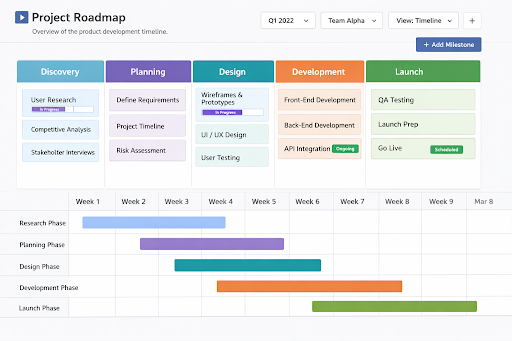
Mobile app development process from UX design prototypes to App Store submission.
A structured app development goes through a series of steps to bring your app idea to successful execution.
Step 1: Discovery & Scope Definition
When you first engage with a company, you must be clear about the objectives you wish to achieve with your mobile app plan. This will set the direction for the mobile app development process, including mapping out the user journey, what’s to be included, and what’s not.
At this stage, a scope document is prepared that serves as a contractual agreement for the terms and conditions governing the process and the deliverables to be expected. This ensures that the project stays on track and doesn’t deviate from its pre-determined goal.
Duration: 1–2 weeks. Deliverables: project brief, feature list, tech stack recommendation, timeline estimate.
Step 2: UX design & Prototyping
The design process comes into action, where the idea is translated into a clickable prototype for your approval before moving on to the next stage. The most effective apps combine a stunning interface and top-notch functionality to ensure that the app doesn’t simply look appealing to users but delivers real value to users.
It’s far cheaper to change a design in Figma in the early stages than to rebuild a coded screen. Skipping the wireframe stage to “save time” would only lengthen the development revisions if flaws surface once the code is written.
Duration: 2–4 weeks. Deliverable: approved Figma prototype.
Step 3: Development Sprints (agile)
Mobile app Development usually runs in two-week agile sprints. At the end of each sprint, you see working software that embodies a new functional, tested feature to gather relevant feedback and help improve processes for the next sprint.
Working in sprints allows for rapid, iterative development where cross-functional teams implement tasks in a sequence or phases, decreasing time-to-market compared to traditional methods.
Dividing an app development project into time-limited slots makes it easier to manage the backlog, adapt to technical challenges, and deliver consistent results.
Step 4: QA testing & beta release
Before any code ships to users, it goes through a rigorous QA process where it is manually tested across real devices and checked for bugs before release.
The resultant product is then released in a beta form for a small group of real users before the final launch. On iOS, this is done via TestFlight, while Android devices have Google Play’s internal testing track.
Duration: 2–4 weeks. Deliverable: tested, beta-approved build.
Step 5: App Store & Google Play submission
Before an app can make it to the App Store or Google Play, it has to go through its review processes. Apple’s review typically takes 1–3 business days, and Google Play typically takes 1–7 days, with specific guidelines
A credible app development company not only submits your app to its intended store but also applies basic App Store Optimization (ASO) techniques. Think of it as SEO for the app that may include optimizing the title and description, using properly formatted screenshots, and assigning it to the right category. This matters because how your app appears in search affects how many people find it organically.
Step 6: Post-launch support & maintenance
Shipping an app marks just another step in the app development process. Every major iOS and Android release requires compatibility updates, while seemingly working features in the test phase could reveal shortcomings in production. In other cases, an app may have to be molded according to user demands or expectations.
Native Vs Cross-Platform: Choosing the Right Architecture
This is one of the top-most queries that clients ask, and frankly, there is no universally best choice. Whether you should opt for OS or Android app development services boils down to the specific details of your product.
| Factor | Native (iOS / Android) | Cross-platform (Flutter / React Native) |
| Performance | Best possible | Near-native (Flutter) / Good (React Native) |
| Cost | Higher — two codebases | Lower — one codebase |
| Time to market | Slower | 30–40% faster |
| Platform-specific features | Full, unrestricted access | Some limitations |
| Developer ecosystem | Mature, platform-specific | Large and growing |
| Best for | Complex apps, gaming, AR/VR, deep hardware access | Startups, MVPs, consistent cross-platform UI |
A 4-Point Checklist for Your Development Pathway
The following questions can give you insights into what development pathway would work for you:
- Does your app require platform-perfect UX or cutting-edge device APIs? Consider native.
- Is speed to market or cost efficiency the primary constraint? → Cross-platform delivers better ROI.
- Will you need deep Bluetooth, background services, or advanced camera workflows? → Validate cross-platform plugin maturity first, or go native.
- Are you building a game, AR experience, or graphics-intensive product? → Go native from day one.
Why Startups Often Lead with Cross-Platform
As a startup or someone new to app development, cross-platform offers a good starting point thanks to its speed and cost advantage. The advent of Flutter’s Skia rendering engine and React Native’s new architecture.have largely lowered the performance gaps encountered in earlier versions.
If your roadmap leans heavily into Bluetooth, background services, advanced camera workflows, or frequent OS feature adoption, validate those capabilities with a short technical spike before committing. If you’re building a gaming app, an AR experience, or something that demands cutting-edge devices’ hardware capabilities, go native from day one.
The Hybrid Strategy: The Best of Both Worlds
For many organizations, hybrid allows tapping into the benefits of a primary cross-platform app, alongside native versions that incorporate device-intensive features. A dedicated custom mobile app development services partner should walk you through these trade-offs without imposing a one-size-fits-all tech stack.
- Native wins for peak performance and deep OS capabilities; cross-platform often delivers on speed and cost.
- Use a decision checklist tied to UX, device APIs, and ROI timeline.
- Hybrid approaches are common in enterprise-grade builds.
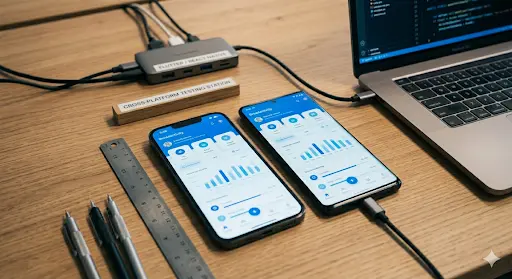
Comparison of native iOS and Android apps vs cross-platform Flutter and React Native development.
How To Choose A Mobile App Development Company
Your prospects of landing the right development partner heavily depend on asking the right questions to evaluate whether it works as a fit for your business. Failure to do so can lead to miscommunication with the risk of an app that doesn’t exactly match your vision.
1. Do they have Proof of Work?
A portfolio is simply a collection of work that an agency claims to have done. This should be backed up by solid proof of currently active and maintained apps that reflect design quality, user experience, and technical stability.
2. Do They Have A Documented Process?
Be cautious about agencies that offer vague answers about “agile methodology”. Instead, be specific about how the agile method works, such as how they handle scope changes or what happens if a sprint runs over. An established, transparent process is the backbone of successful development.
3. Who Owns the IP from Day One?
There should be clarity about who owns the code, designs, and data from day one. This should be explicitly highlighted in the initial contract you sign with an agency to avoid “vendor lock-in” or legal confusion if you ever decide to move the project to an in-house team or another agency.
4. What Does Communication Look Like?
Credible agencies take communication seriously and deploy multiple channels like weekly demos, Slack access, and a designated project manager as part of the development process. If you cannot track the project’s daily or weekly progress, you’ll jump straight into chaos once the final product arrives.
5. Do They Have Domain Experience In Your Industry?
All apps rely on a standard development process, but the dynamics differ from industry to industry. In other words, a fintech app comes with specific compliance requirements that differ from the conversion features an e-commerce app is supposed to have. An agency with specific domain knowledge shortens the learning curve and reduces costly mistakes.
6. What Does Post-Launch Support Look Like?
The launch is just the beginning. The agency that builds your app is the lowest-risk choice to maintain it, as they already know the codebase intimately. Before signing a build contract, find out what their post-launch retainer model looks like for bug fixes, OS updates (like iOS or Android version changes), and feature scaling.
7. Can They Contribute Beyond Development?
While specializing in app development is a key requirement, a shop that is equally well-versed in other domains like digital marketing, ASO, and growth strategy can add more value to the final product. Choosing a partner who understands the “big picture” ensures your app doesn’t just work well—it actually reaches your target audience.
Ready to Build Your App
Ready to evaluate Crossway Consulting for your project? Book a discovery call to tell us about your dream app, and we’ll prepare a roadmap to turn it into a high-performance, revenue-generating reality.
Explore More: Related Guides
| → Is Flutter Really That Good? Flutter Mobile App Development 2026 |
Frequently Asked Questions
What is included in mobile app development services?
Most end-to-end mobile app development services cover the full cycle of app development from discovery, UX/UI design, iOS/Android, or cross-platform development to backend/API, app store, and Google Play submission with ASO, and post-launch maintenance. Make sure to ask for sample deliverables, as these are likely to vary from company to company.
How much do mobile app development services cost?
Mobile app development costs vary depending on scope, chosen platforms (iOS/Android vs both), number of integrations, UX complexity, security/compliance needs, etc. A basic MVP for a single platform can cost around $15,000, whereas a complex enterprise app packed with features can cost over $300,000, while mid-market projects lie in the range of $40,000 and $120,000.
Do I need an MVP before a full app?
In most cases, yes. An MVP lets you validate your core assumption with real users before committing to full-scope development. It reduces financial risk, gives access to user feedback early, and expedites time-to- market by 30–50%. The MVP acts as the foundation on which the full product is built, not a disposable.
How do I choose a mobile app development company?
Look at their live portfolio, not just case studies, ask for a detailed process walkthrough, confirm whether you’ll own all IP from day one, and find out whether they provide post-launch support. Prefer agencies that prioritize open communication and transparency in answering specific questions about how they handle scope changes, timeline overruns, or production bugs.
Should I build a native or cross-platform app?
For most startups and SMBs, cross-platform, be it Flutter or React Native, is the better starting point, as it utilizes a single codebase that results in high performance, faster time-to-market, and lower costs. Go native from day one if your app requires peak graphics performance, deep OS integration, or platform-specific features that cross-platform frameworks can’t support.