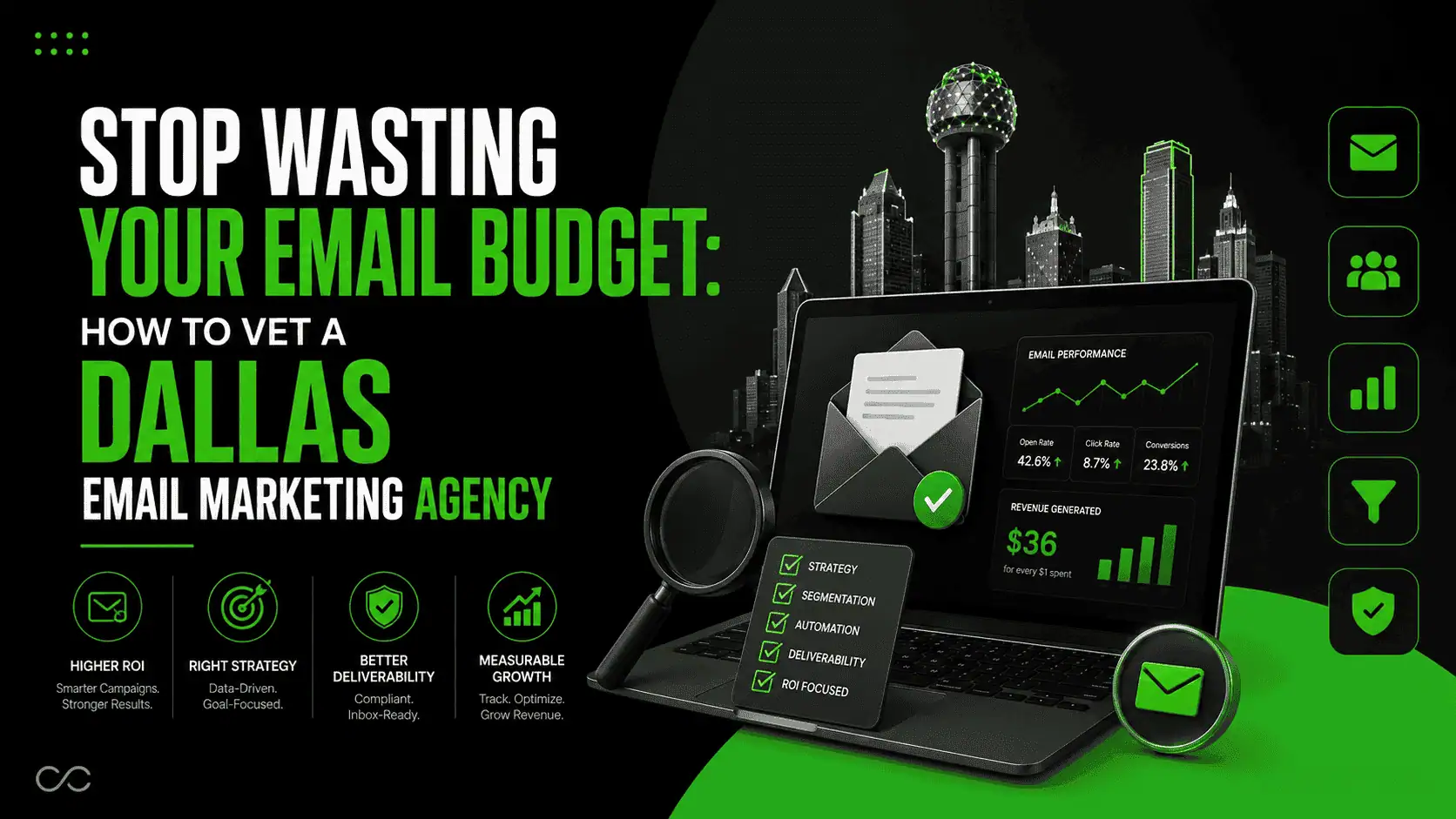
Email remains one of the highest-returning channels in digital marketing, delivering an average of $36 for every $1 spent, according to Litmus’s State of Email research. But that return depends entirely on execution. A poorly run email program — misaligned messaging, unclean lists, automations nobody maintains — can just as easily produce a stagnant list and a wasted budget.
That gap between the two outcomes is almost always decided by who runs the program. For a Dallas business evaluating agencies, the difference between a partner who treats email as a strategic revenue channel and one who treats it as a bulk-send checkbox is worth understanding before you sign a contract. Here’s what to actually look for.
Why the Right Agency Choice Matters More Than the Right Platform
It’s tempting to think the platform — Klaviyo, Mailchimp, HubSpot, or another ESP — is the decision that matters most. In practice, the platform is a tool. The strategy behind how it’s used is what determines results.
Two businesses on the same platform, sending to similarly sized lists, can see wildly different outcomes depending on whether their emails are segmented, tested, and tied to revenue goals, or sent as generic one-size-fits-all blasts. Research from Campaign Monitor has found that segmented email campaigns generate significantly more revenue than non-segmented ones, which is a large part of why agency expertise in strategy and segmentation matters more than which software logo sits on the dashboard. (For a quick primer on the tactics that move the needle, see our guide to email marketing tips to grow your marketing.)
Strategy first
Asks about your sales cycle before opening a template
Platform integration
Syncs with your CRM or e-commerce stack for real segmentation
Compliance & deliverability
Handles CAN-SPAM, SPF, DKIM, and DMARC properly
Revenue-tied reporting
Reports click-to-conversion and revenue per email, not just opens
Industry experience
Can speak to what worked and what didn’t in comparable work
What to Evaluate Before Hiring an Email Marketing Agency
1. A Strategy-First Approach, Not a Templates-First Approach
Ask what the agency does before it ever opens the email builder. A qualified partner should want to understand your sales cycle, your existing list health, your CRM or e-commerce platform, and your revenue goals before recommending a single campaign. If the first conversation jumps straight to template design, that’s a signal the agency is optimizing for sends, not for outcomes.
2. Platform and Integration Expertise
Your email program needs to talk to the rest of your stack — your website, your CRM, your e-commerce platform if you run one. Ask which platforms the agency has hands-on experience with (Klaviyo for e-commerce, HubSpot for B2B, and Mailchimp for general-purpose sending are among the most common), and how they handle data syncing so that segmentation is based on real customer behavior rather than guesswork.
3. Compliance and Deliverability Knowledge
This is a nontechnical-sounding area where a surprising number of agencies fall short. Under the CAN-SPAM Act, every commercial email sent to a U.S. recipient must include accurate header and subject-line information, a valid physical postal address, and a working opt-out mechanism that’s honored promptly. Beyond legal compliance, deliverability itself has gotten more technical: Google and Yahoo now enforce authentication requirements (SPF, DKIM, and DMARC) for any sender pushing meaningful volume, and failing to meet them can mean your emails never reach the inbox at all, regardless of how good the content is. Ask a prospective agency how they handle authentication setup and list hygiene — the answer will tell you a lot about how seriously they take deliverability.
4. Reporting Tied to Revenue, Not Vanity Metrics
Open rates are a weak signal on their own, particularly since Apple’s Mail Privacy Protection began pre-loading tracking pixels, which inflates reported open rates independent of actual engagement. A capable agency should report on metrics that connect to your bottom line: click-to-conversion rate, revenue per email, and how automated flows (welcome series, abandoned cart, win-back) are performing against manual campaigns. If open rate is the headline metric in every report you receive, ask why.
5. Experience in Your Industry
Email strategy differs meaningfully between an e-commerce store recovering abandoned carts, a real estate team nurturing a multi-month buyer journey, and a professional services firm building trust through a newsletter. Ask for examples of work in a comparable industry, and ask specifically what worked and what didn’t — a confident agency will be able to speak to both.
If email is one piece of a larger gap in your marketing — not just the list you’re not emailing, but the traffic and leads feeding that list — it’s worth evaluating agencies through that wider lens too. Our guide on choosing a digital marketing agency for a small business covers the same vetting principles applied across channels.
Red Flags to Watch For
A few warning signs are worth taking seriously during the vetting process:
- No question about your existing list quality. List hygiene affects deliverability directly; an agency that doesn’t ask how your list was built or how often it’s cleaned may be setting you up for spam-folder placement.
- Vague answers about automation maintenance. Automations aren’t “set and forget.” An agency should be able to explain how often flows are reviewed and updated.
- Reluctance to define measurable goals up front. If an agency won’t commit to specific KPIs before starting, it’s harder to hold the engagement accountable later.
- One-size-fits-all packages regardless of business type. Email strategy should reflect your sales cycle and customer base, not a fixed template applied to every client.
Questions Worth Asking in a Discovery Call
- How do you approach list segmentation, and what data do you use to build segments?
- What does your onboarding and data-integration process look like?
- How do you handle CAN-SPAM compliance and sender authentication (SPF/DKIM/DMARC)?
- What metrics will I see in my monthly reporting, and how do they connect to revenue?
- Can you walk me through a campaign or automation you built for a business similar to mine, and what the actual outcome was?
How Crossway Consulting Approaches Email Marketing for Dallas Businesses
At Crossway Consulting, every engagement starts with a full audit of your existing email program before any campaign gets built — because you can’t fix what you haven’t measured. From there, we handle strategy, list segmentation, campaign design, automation setup, and deliverability monitoring as one connected system, reporting against the metrics that actually reflect revenue rather than vanity opens. If you’re currently evaluating email marketing services in Dallas and want a second opinion on where your current program stands, a free email audit is the most useful place to start.
Frequently Asked Questions
How much does an email marketing agency in Dallas typically cost?
Pricing varies widely based on list size, campaign volume, and whether automation build-out is included, so it’s worth getting a scoped proposal rather than comparing flat rates. Ask what’s included in the base fee (strategy, design, copywriting, automation maintenance) versus what’s billed separately.
What questions should I ask before hiring an email marketing agency?
At minimum, ask how they approach list segmentation, what their onboarding and data-integration process looks like, how they handle CAN-SPAM compliance and sender authentication, what metrics appear in your reporting, and for a specific example of a campaign or automation they’ve built for a similar business.
Do I need a large email list before hiring an agency?
No. A capable agency should be able to help you grow a small list the right way — through opt-in forms, lead magnets, and list-building tactics — rather than requiring a minimum list size to start. What matters more than list size is list quality and engagement.
How is email marketing ROI usually measured?
The industry benchmark is around $36 in revenue for every $1 spent, according to Litmus’s State of Email research, though results vary by industry and list quality. A good agency will track revenue per email and click-to-conversion rate alongside opens and clicks, since open-rate data has become less reliable since Apple introduced Mail Privacy Protection.
What’s the difference between email marketing automation and a one-off campaign?
A campaign is a single send — a newsletter or promotion sent to your whole list at once. Automation refers to triggered sequences (welcome series, abandoned cart, re-engagement) that run continuously based on subscriber behavior. Most effective email programs use both.
The Bottom Line
Choosing an email marketing agency in Dallas comes down to one core question: does this team treat email as a measurable revenue channel, or as a task to check off the marketing calendar? The agencies worth hiring will ask more questions than they answer in a first conversation, will talk about your list and your compliance posture before they talk about templates, and will be comfortable being measured against outcomes — not opens.