




An outdated website doesn’t just look dated it actively costs you visitors, leads, and search visibility. Slow load times, non-responsive layouts, and clunky navigation push people away before they ever see what you offer, and the same issues that frustrate visitors also work against you in Google’s rankings.
At Crossway Consulting, we redesign websites with a clear goal: turn your site into a platform your team can actually manage, that loads fast, and that’s structured to convert visitors into leads or customers not just a fresh coat of paint over the same underlying problems.
A website redesign is a comprehensive update to a site’s design, structure, and often its underlying platform — distinct from smaller, incremental changes like updating a homepage banner or adjusting colors. A redesign typically touches information architecture, page templates, mobile responsiveness, and sometimes the Content Management System (CMS) itself. If you’re evaluating whether you need a full platform change rather than a visual refresh, our CMS Development Services page covers that decision in more detail.
Every redesign starts with an audit of your current site: what's working, what's actively losing you visitors, and what content or pages are already earning search visibility that we need to protect through the transition. Skipping this step is the most common reason redesigns lose traffic instead of gaining it.
Google evaluates page experience using Core Web Vitals — Largest Contentful Paint (LCP), Interaction to Next Paint (INP), and Cumulative Layout Shift (CLS). We build with these thresholds in mind from the start, rather than trying to optimize a slow site after launch, when fixes are far more expensive.
A redesign is one of the highest-risk moments for organic search traffic if it's handled without a plan. We map your existing URLs to their new structure, implement 301 redirects where URLs change, and preserve metadata and structured data — so your redesign improves the site without resetting the rankings you've already earned.
We build redesigns on CMS frameworks (typically WordPress, though the right platform depends on your needs) so your team can manage content, publish updates, and run campaigns without depending on a developer for every change. Full platform details are covered on our CMS Development Services page.
Since Google evaluates the mobile version of your site for indexing and ranking, we test and refine the mobile experience as a primary deliverable, not a secondary check after the desktop design is finalized.
After launch, we monitor rankings, traffic, and Core Web Vitals scores to catch and correct any issues quickly, rather than assuming the redesign is complete the moment it goes live.
A redesign touches nearly every ranking signal Google evaluates: page speed, mobile usability, content structure, and internal linking. Handled well, a redesign is an opportunity to improve all of these at once. Handled without a plan, it’s one of the fastest ways to lose search visibility — broken redirects, thin or duplicated content, and slower load times are common redesign mistakes that directly work against Google’s page experience and E-E-A-T (Experience, Expertise, Authoritativeness, Trustworthiness) standards, which Google’s 2026 core updates have continued to reinforce. We treat the SEO migration plan as a core deliverable of every redesign, not a follow-up task after launch.
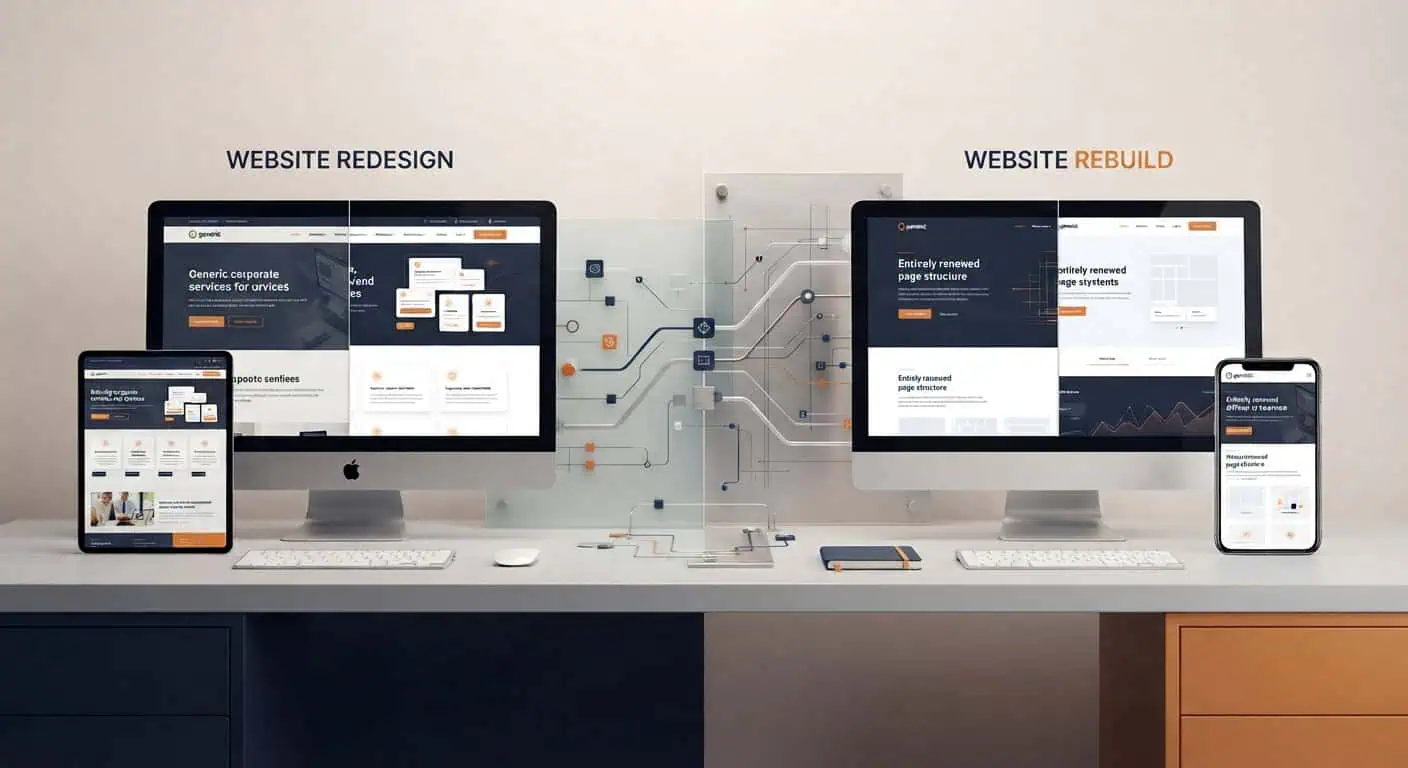
Not every outdated site needs a full rebuild. If your core structure and content still serve your business but the design, speed, or mobile experience are holding you back, a redesign on your existing platform may be enough. If your current CMS itself is limiting your team’s ability to manage content, or can’t support your growth plans, a platform change may be the better investment — covered in more depth on our CMS Development Services page. We’ll help you determine which applies to your situation during the audit phase, rather than defaulting to the larger, more expensive option.

Healthcare & MedTech
HIPAA-compliant telehealth platforms, patient portals, wearable integrations, EHR apps, clinical workflow tools, and remote monitoring solutions.

E-Commerce & Retail
Mobile storefronts, loyalty apps, AR try-on features, inventory management, omnichannel experiences.

Fintech & Banking
Secure payment apps, digital wallets, investment platforms, loan origination tools, and regulatory-compliant financial dashboards.

Logistics & Transportation
Fleet management, driver apps, route optimization, vehicle diagnostics, and customer booking apps.

Real Estate & PropTec
Property search apps, virtual tours, mortgage calculators, CRM integrations, agent tools.

Maritime & Cargo
Intuitive cargo management platforms with real-time tracking and compliance features.

Redesign scope varies significantly based on a few core factors: the number of unique page templates your site needs, whether you’re changing CMS platforms or staying on your current one, how many third-party integrations (CRM, payment processing, booking tools) need to carry over, and how much existing content needs to be migrated versus rewritten. A five-page brochure site and a two-hundred-page resource library require very different levels of effort, even if both are described as a “redesign.” We scope each project individually rather than applying a flat rate that doesn’t reflect the actual work involved.
It can, if it's done without a migration plan — but it doesn't have to. The most common causes of ranking loss during a redesign are broken URLs, missing redirects, and lost metadata. We map your existing URL structure before development starts, implement 301 redirects for any URLs that change, and carry over your metadata and structured data, so the redesign builds on your existing search equity instead of resetting it.
Timelines depend on site size, content volume, and the complexity of any integrations (CRM, e-commerce, third-party tools). We give a specific timeline estimate once we've scoped your project during the audit phase — we don't quote a generic timeframe before understanding what your site actually needs.
A phased redesign is often the right call for larger sites, especially if certain pages or sections are already performing well and shouldn't be disrupted. We can scope a redesign around your highest-priority pages first, or plan a full-site rebuild — depending on your budget, timeline, and risk tolerance.
A redesign updates the look, structure, and user experience of your site, often on your existing platform. Switching CMS platforms is a bigger technical change that also affects how your team manages content going forward. Sometimes a redesign includes a platform change; sometimes it doesn't. We'll clarify which you actually need during the audit rather than assuming.
Yes. Mobile responsiveness is treated as a primary requirement, not a secondary check, since Google indexes and ranks based primarily on the mobile version of your site.