

Crossway Consulting plans, builds, and manages SEM campaigns across Google, Microsoft Advertising (Bing), Amazon, and ecommerce shopping networks — so you’re generating qualified traffic while your organic strategy compounds in the background.
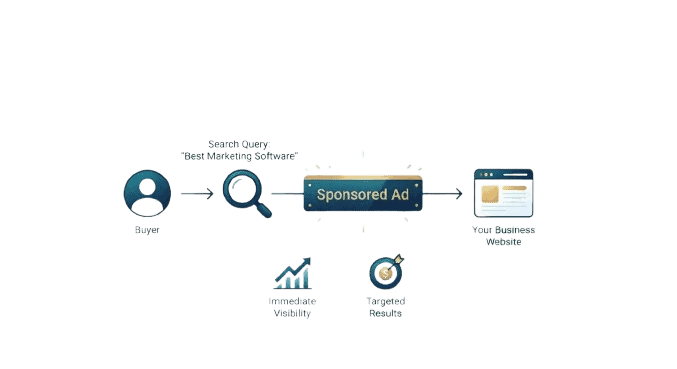
Organic rankings take time to earn. Paid search campaigns can start driving qualified clicks the same week they launch, giving you a way to test messaging, capture demand, and generate leads without waiting on the algorithm.
Your ads can appear on page one as soon as a campaign is approved and live — no ranking curve to climb first.
Bid on the exact keywords, locations, devices, and audiences that match your ideal customer, and adjust in real time.
You set daily and monthly caps. Spend only pulls the levers you approve, and every dollar is tracked back to a result.
Conversion tracking shows exactly which campaigns, ads, and keywords are producing leads or sales — not guesswork.
Each service below is its own dedicated engagement — pick one channel or combine several as part of one coordinated SEM strategy.We give a project-specific estimate after a discovery conversation grounded in your actual requirements — not a generic range that doesn’t reflect the build.
Search, Shopping, Display, and Performance Max campaigns on Google Ads — built around the keywords and audiences most likely to convert, with ongoing bid and budget management.
Campaigns on Microsoft Advertising, reaching audiences across Bing, Yahoo, AOL, and the Microsoft Search Network — often at a lower cost per click than Google alone.
Sponsored Products, Sponsored Brands, and display campaigns that put your listings in front of shoppers actively searching and browsing on Amazon.
Shopping and retargeting campaigns built for online stores — product feed optimization, dynamic ads, and cart-recovery strategies designed to lift ROAS.
No black box. Here’s the process behind every campaign we run.
We look at your goals, budget, competitors, and any existing campaigns to see what's working, what isn't, and where the opportunity is.
Based on the audit, we decide which platforms and campaign types are worth your budget, and outline the approach before anything goes live.
Conversion tracking, keyword research, ad copy, and audience targeting are built and tested before a single dollar goes toward ad spend.
We monitor performance and adjust bids, budgets, keywords, and creative on an ongoing basis to keep cost-per-click and conversions moving in the right direction.
Monthly reports tie performance directly to the KPIs you actually care about — leads, sales, cost per acquisition — not vanity metrics.
Traditional advertising asks you to spend first and hope for results later. SEM flips that: every campaign is measurable from day one, and every dollar is traceable to a click, a lead, or a sale.
Because SEM results show up fast, it’s also the clearest way to test messaging and offers before committing that same insight to slower-moving channels like SEO or print. Our team manages bids and budgets closely to keep your cost-per-click efficient and your return on ad spend moving in the right direction — while your organic SEO strategy builds toward the same audience in parallel.
Regardless of which platform or platforms you choose, these are the pieces we set up and manage as standard.
Most businesses eventually run both. Here’s how they differ so you can decide where to start.
| SEM (Paid Search) | SEO (Organic Search) | |
|---|---|---|
| Time to results | Traffic can start within days of launch | Typically months to build rankings |
| Cost structure | Pay per click, ongoing ad spend | Upfront and ongoing content/technical investment, no per-click cost |
| Visibility | Ends when the campaign stops | Persists as long as rankings hold |
| Control | Precise targeting by keyword, audience, location, device | Influenced by content and technical signals, less direct control |
| Best for | Immediate leads, testing offers, seasonal pushes | Long-term, compounding organic traffic |

Healthcare
Patient acquisition campaigns built around compliant, trust-first messaging.

Automotive
Local inventory and service campaigns tied to dealership goals.

Finance
Lead campaigns designed around trust, accuracy, and compliance.

Education
Enrollment-focused campaigns for schools and ed-tech programs.

Real Estate
Listing and lead-gen campaigns tied to local market demand.

Hospitality
Booking-focused campaigns tuned to seasonal demand shifts.
SEM is paid advertising placed on search engines and their partner networks — think Google Search, Google Shopping, Microsoft Advertising (Bing), and Amazon. Advertisers bid on keywords or product placements and typically pay per click. It's distinct from SEO, which grows visibility through unpaid, organic rankings.
SEO builds organic visibility through content, technical optimization, and backlinks — it takes longer to show results but doesn't cost per click. SEM is paid placement that can start generating traffic as soon as a campaign launches. Most businesses get the best return from running both together: SEM for immediate visibility, SEO for sustainable, long-term traffic.
We manage campaigns on Google Ads (Search, Shopping, Display, and Performance Max), Microsoft Advertising (Bing, Yahoo, and the Microsoft Search Network), and Amazon Ads (Sponsored Products and Sponsored Brands), along with ecommerce-specific shopping and retargeting campaigns.
SEM has two cost components: your ad spend (paid directly to the platform — Google, Microsoft, or Amazon) and our management fee for strategy, campaign setup, and ongoing optimization. Pricing depends on your monthly ad budget, the number of platforms involved, and whether SEM is bundled with other services like SEO. We'll walk you through specific numbers during a consultation.
Campaigns can start generating clicks and impressions as soon as they go live, typically within the first week. Meaningful conversion data and optimization opportunities usually take a few weeks to accumulate, since the algorithms on each platform need real performance data before bidding and targeting can be fine-tuned.
Minimum effective budgets vary by industry, competition, and platform — a local service business and a national ecommerce brand will need very different spend levels. We'll help you set a realistic starting budget based on your goals and market during your consultation, rather than a one-size-fits-all number.
It depends on where your customers actually search. Google Ads covers the largest share of search traffic, so it's typically the starting point. Microsoft Advertising is worth adding when you want lower cost-per-click on a smaller but often more affluent, desktop-heavy audience. Amazon PPC and ecommerce PPC make sense if you sell products online. We'll recommend a combination based on your goals rather than running every channel by default.
We tie every campaign to conversion tracking set up before launch — form fills, calls, purchases, or whatever action matters most to your business. From there, we report on cost per conversion, click-through rate, and return on ad spend, so you can see plainly whether the spend is producing results, not just clicks.
Tell us about your goals and budget, and we’ll map out which SEM channels are worth your investment.