

Custom social networking apps for founders, brands, and organizations who want to own their community instead of renting it from someone else’s algorithm — on iOS, Android, and the web.
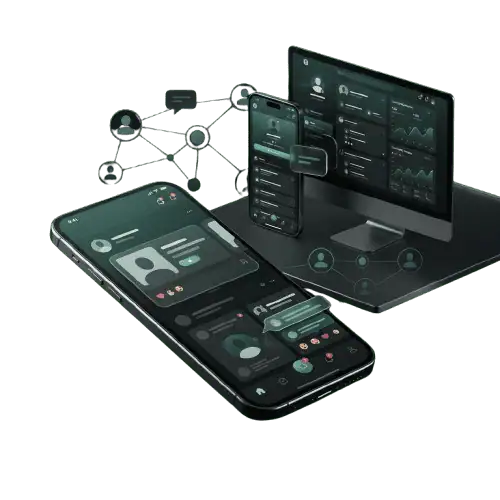
It's easy to assume a handful of giants already own this space and there's no room left. The numbers tell a different story. That global audience isn't consolidating into fewer platforms — it's splitting into thousands of smaller, more specific communities built around professions, hobbies, health conditions, cities, faiths, and interests the big networks were never built to serve well.
That fragmentation is where custom social platforms earn their keep. A general-purpose network can't give your users the moderation standards, the niche discovery tools, or the business model your community actually needs. A purpose-built app can — and it gives you something a public platform never will: ownership of the data, the experience, and the monetization strategy.
Personalized feeds and thoughtful notifications keep people coming back because the platform is built around what they came to do.
Every discussion and connection your users create adds value to the platform — a moat competitors can't clone.
Subscriptions, memberships, creator tools, marketplaces, and advertising can all live in one platform, with no revenue split.
Behavioral and engagement analytics that live in your own system — not locked inside someone else's dashboard.
“Social app” covers a lot of ground, and the right technical approach changes depending on what kind of community you’re serving. Here’s where we spend most of our time:
Professional networking
Interest-based communities
Creator platforms
Enterprise collaboration
Media sharing
Live streaming
Discussion forums
Dating & matchmaking
Event networking
Educational communities
Healthcare social platforms
Sports & fitness
Gaming communities
Marketplace-driven social
Whatever category your platform falls into, the goal is the same: fast, intuitive, secure interactions today, and enough architectural headroom to add new features tomorrow without starting over.
There’s a version of engagement built on manipulation — infinite scroll with no stopping point, notifications designed to create anxiety, dark patterns that trade trust for a metric. We don’t build that version. Engagement should be a byproduct of genuine value, not the product itself.
New users should find their first meaningful interaction within minutes, not wander through an empty feed wondering why they signed up.
Ranking logic tuned to what your specific users are trying to accomplish — not borrowed from a general-purpose algorithm built for someone else's audience.
Every push notification is a small withdrawal from a trust account. We design around genuinely relevant moments, not send-volume maximization.
A confirmation before a public post, a pause before an angry message — small choices that protect the community without slowing the experiences users came for.
Good social apps aren’t a checklist of features bolted together — they’re a set of systems that work well together. Here’s how we typically structure that system.
Rich, customizable profiles with verification options and granular visibility settings.
Text, photo, video, stories, and long-form content with fast compression and delivery pipelines.
1:1 and group messaging with read receipts, typing indicators, and optional voice/video calling.
Groups and channels with their own membership rules, moderation, and content feeds.
Ranking logic that surfaces relevant content and people, tuned to your platform's actual goals.
Likes, reactions, threaded comments, shares, and mentions built to feel fast at scale.
Push, in-app, and email systems tuned to bring users back without training them to ignore alerts.
Reporting, moderation workflows, blocking, and guideline enforcement built in from day one.
Subscriptions, creator payouts, in-app purchases, and marketplace transaction support.
Back-office dashboards giving your team visibility into growth, engagement, and moderation queues.
Fast, relevant search across people, content, and communities with useful filters.
Interfaces built to accessibility standards from the start for screen readers and assistive tech.
AI has moved from “nice to have” to infrastructure that makes a modern social platform work better. Where it makes sense for your platform, we build in:
Feed ranking that learns from real user behavior, not just recency or popularity.
AI-assisted screening paired with human review for judgment calls automation shouldn't make alone.
Semantic search that understands intent, not just keyword matches.
In-app assistants that help users navigate the platform or get support.
Behavioral pattern analysis that flags bots and coordinated inauthentic activity.
Optional assist tools for captions and summaries — never a replacement for a real human voice.
Social platforms handle some of the most sensitive data a business can be responsible for: identity information, private messages, location data, and behavioral history. We build security in from day one, not as an afterthought before launch.
Protecting messages, media, and personal information.
OAuth 2.0 and multi-factor authentication so account takeovers stay rare.
Internal teams only see and manage what their role requires.
Real control over what users share and who can see it.
GDPR, CCPA, and HIPAA-aware architecture for regulated data.
Vulnerability assessments as part of our development and maintenance process.
A single trust-and-safety failure can end a social platform faster than slow growth ever will. We treat security as a feature users are entitled to, not a line item to trim.
AI has moved from “nice to have” to infrastructure that makes a modern social platform work better. Where it makes sense for your platform, we build in:
Native iOS in Swift, built on Apple's current frameworks for performance and deep device integration.
Native Android in Kotlin, built to perform across a wide and fragmented range of devices.
Scalable cloud architecture with real-time infrastructure and CDN-backed media delivery.
RESTful and GraphQL APIs with modular architecture for adding capabilities as you grow.
WebSockets, message queues, and pub/sub architecture built to scale horizontally.
Automated pipelines, staging environments, and performance monitoring on every platform we ship.
Choosing between native and cross-platform isn’t one-size-fits-all — it depends on your target platforms, timeline, budget, and how deeply you need device-specific integration. We’ll walk through the tradeoffs before recommending an approach.
Most social platforms don’t fail because the idea was wrong — they fail because the technical foundation couldn’t support the growth the idea eventually earned. We design for growth from the first architecture decision.
Structured so that as post counts, messages, and connections grow into the millions, query performance doesn't degrade.
Cloud infrastructure that adds capacity by adding servers, not one increasingly expensive machine.
Photos and video served from edge locations close to your users, wherever your community grows.
Reduced load on your core database for the data users request most, so performance holds under traffic spikes.
Messaging, media processing, and notifications built as separable services so one part scales without taking down the rest.
Spam, harassment, impersonation, and policy-violating content aren’t edge cases — they’re predictable. Planning for them is responsible product development, not an afterthought bolted on after a crisis.
AI-assisted detection for spam and obvious violations, so the worst content never reaches other users.
Fast, manageable queues for flagged content, appeals, and reports where context and judgment matter.
Simple ways to report and block, with visibility into what happens next — ignored reports erode trust fast.
Visible and consistently enforced, not buried in a terms-of-service document nobody reads.
Clear internal processes for harassment, safety threats, or illegal content beyond standard queues.
Building a social platform is a bigger undertaking than most software projects — more surface area, more moving parts, more that can go wrong if the foundation isn’t right.
Understanding your users, business model, and competitive landscape before a single screen gets designed.
Wireframes and prototypes test core flows before high-fidelity design and engineering time are committed.
Database, API, real-time infrastructure, and the native-vs-cross-platform decision, mapped out up front.
Iterative sprints with regular check-ins — core features prioritized so the platform has a usable core early.
Functional, performance, security, and accessibility testing across the devices your users actually run.
App Store and Google Play submission, cloud deployment, monitoring, and analytics configuration.
Bug fixes, monitoring, security updates, and iteration based on real usage data after launch.
Building a social platform is a bigger undertaking than most software projects — more surface area, more moving parts, more that can go wrong if the foundation isn’t right.
A messaging-and-profiles MVP is a very different build from a platform with live streaming and AI-driven recommendations.
Native iOS and Android built separately takes longer than a shared cross-platform codebase.
Real-time features, high-volume media handling, and moderation systems all add engineering time.
A highly custom, brand-specific interface takes longer than a more standard layout.
Payment processing, identity verification, and third-party APIs each add scope.
Healthcare, finance, or regulated regions may need extra architecture and testing — HIPAA, GDPR, and similar.
We’ll give you a real, project-specific estimate after a discovery conversation — not a placeholder number designed to get you on the phone.
We’re a full-service digital agency, so your social platform doesn’t exist in isolation from the rest of your business. Design, engineering, and strategy stay in-house — one accountable team instead of disconnected vendors.
If a feature will meaningfully extend your timeline or budget, we say so upfront and help you weigh the tradeoff.
We hold our own marketing to the same standard we'd want from a vendor — no invented statistics, ever.
The people who architect your platform are accountable for how it performs after launch.
Our designers and developers work together from day one — no clunky UI, no unbuildable design.
Timeline depends heavily on feature scope, platform coverage, and backend complexity. A focused MVP takes meaningfully less time than a full-featured platform with live streaming and AI-driven recommendations. We'll give you a specific timeline after a discovery session.
Native development (Swift, Kotlin) gives the best performance and deepest device access, but means two codebases. Cross-platform frameworks share one codebase across both platforms and can reduce cost and speed up development, with a small tradeoff in device-level integration. We'll walk through which fits your goals.
A combination of automated screening for likely violations and spam, paired with human review workflows for judgment calls automation handles poorly. The right balance depends on your community size, content types, and risk profile.
Yes. Monetization strategy is part of our discovery process. We'll look at your user base, content types, and business goals to help determine subscriptions, memberships, advertising, marketplace transactions, or a combination — and build the billing infrastructure to support it.
Launch isn't the finish line. We provide ongoing support including bug fixes, performance monitoring, security updates, and feature development based on real usage data.
Yes. For platforms handling regulated data, such as patient information under HIPAA, we build compliance into the architecture from the start rather than retrofitting it later, which is both safer and less expensive.
In many cases, yes. If your current platform has a working user base but is held back by outdated architecture or a UI that no longer serves your users, we can assess whether a rebuild, phased migration, or targeted redesign makes the most sense.
For most new platforms, we recommend a focused MVP — core profiles, content, and messaging — expanded based on real user behavior. Some categories, like dating or marketplace platforms, need a slightly broader baseline (verification, trust and safety tooling) to be viable from day one.
It depends on how your users will primarily access the platform. Mobile-native apps give better performance and offline capability; a responsive web platform can be faster to launch and makes sense where desktop access matters. Many clients launch both, sharing backend infrastructure.
Every major social network started as a smaller, more focused idea. If you have a clear vision for the community you want to build, the technical execution shouldn’t be what holds you back.A well-built iOS app should feel like it belongs on the platform — fast, secure, and designed the way Apple users expect.