

E-Commerce CMS Development
A Store Platform Built to Sell — and Built for Your Team to Manage
An e-commerce site has to do two jobs at once: convert visitors into customers, and let your team manage products, inventory, and content without depending on a developer for every update. Too often, businesses end up with a platform that does one or the other — not both.
At Crossway Consulting, our e-commerce CMS development integrates with WooCommerce, Shopify, Magento, and other leading platforms to give you a store that’s fast, secure, and genuinely easy for your team to run day to day — from product updates to promotions to content marketing around your catalog.

Start Your Digital Transformation Today!
Why E-Commerce Needs Its Own CMS Strategy
A standard content-focused CMS and an e-commerce platform solve different problems. Product catalogs, inventory sync, checkout flows, payment processing, and shipping logic all add complexity that a general CMS wasn’t built to handle on its own. At the same time, an e-commerce platform with weak content management tools makes it hard to run blog content, landing pages, or SEO-driven category pages alongside your product listings. Choosing the right combination — or the right unified platform — matters more for e-commerce than for a standard content site.

Platforms We Work With
For WordPress-based stores that need deep content integration alongside product sales, or that benefit from WordPress's open plugin ecosystem. See our CMS Development Services page for more on WordPress specifically.
For businesses that want a managed, hosted platform with strong out-of-the-box e-commerce tooling and lower ongoing technical maintenance.
For larger or more complex catalogs that need extensive customization, multi-store management, or B2B-specific functionality.
We'll help you evaluate which platform fits your catalog size, growth plans, and internal technical resources rather than defaulting to whichever platform is easiest for us to build on.
Our E-Commerce CMS Services
Store Setup and Custom Development
From initial store build to custom functionality your off-the-shelf platform doesn’t support natively, we build e-commerce sites structured around your product catalog and sales process — not a generic storefront template.
Platform Migration
Moving between e-commerce platforms (or from a custom-built store to a CMS-integrated one) carries real risk to product data, customer accounts, and SEO if it’s not planned carefully. We map your existing product URLs, implement redirects, and preserve product metadata and reviews through the migration.
Content and Product SEO
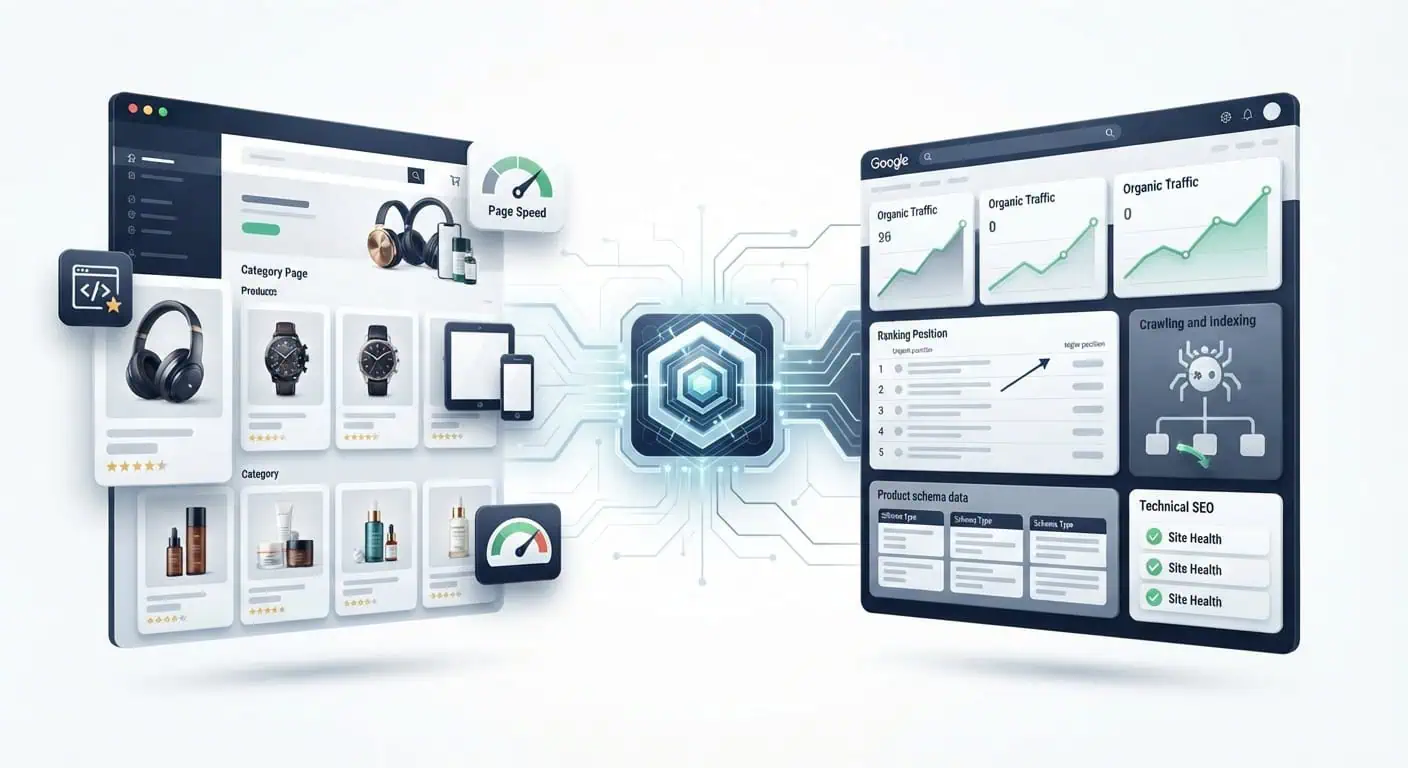
Product pages need to do double duty as sales pages and search-visible content. We structure product titles, descriptions, and schema markup to support both conversion and search visibility, rather than treating SEO as an afterthought layered on top of a finished store.
Performance Optimization
E-commerce sites tend to carry more page weight than content sites — product images, variant selectors, cart functionality — which makes performance optimization especially important. We optimize for Google’s Core Web Vitals thresholds (Largest Contentful Paint, Interaction to Next Paint, and Cumulative Layout Shift) throughout the build.
ERP, CRM & Payment Integrations
We connect your store to inventory management systems, CRMs, and payment gateways so your e-commerce platform operates as part of a connected business system, not an isolated sales channel.
Ongoing Maintenance & Support
E-commerce platforms require more frequent updates than a standard content site, particularly around payment security and plugin/extension compatibility. We provide ongoing monitoring and updates to keep your store secure and functional.
Why Choose Crossway Consulting for E-Commerce CMS Development?
We recommend WooCommerce, Shopify, or Magento based on your business, not our preference.
Product updates, promotions, and content changes shouldn't require a developer.
Structured data and content strategy are part of the build, not a separate add-on.
If you're switching platforms, we protect your existing product data, customer accounts, and search rankings through the process.
We optimize for the added page weight e-commerce sites typically carry, rather than treating speed as secondary to functionality.
E-Commerce SEO and Google's Evolving Ranking Standards
Google’s core updates — including its 2026 releases — continue to emphasize genuinely helpful, well-structured content, a standard that applies directly to product and category pages, not just blog content. Thin product descriptions, duplicate content across variant pages, and missing structured data all work against an e-commerce site’s visibility. We structure product pages with unique, useful descriptions, properly implemented schema markup (product, review, and pricing data), and clean category architecture, so your store is built to meet current search standards rather than relying on tactics that may not hold up as algorithms continue to evolve.

What to Expect During an E-Commerce Platform Evaluation
Before recommending a platform, we look at your current or planned catalog size, average order complexity (simple products vs. variants, bundles, or subscriptions), your team’s technical comfort level, existing systems that need to integrate (accounting, fulfillment, POS), and your growth timeline. A store selling fifty simple products has very different needs than one managing thousands of SKUs with complex variant logic — and the right platform for one is often the wrong choice for the other. We walk through these factors with you before recommending a specific platform, rather than starting the conversation with a platform already decided.
industries we serve.

Healthcare & MedTech
HIPAA-compliant telehealth platforms, patient portals, wearable integrations, EHR apps, clinical workflow tools, and remote monitoring solutions.

E-Commerce & Retail
Mobile storefronts, loyalty apps, AR try-on features, inventory management, omnichannel experiences.

Fintech & Banking
Secure payment apps, digital wallets, investment platforms, loan origination tools, and regulatory-compliant financial dashboards.

Logistics & Transportation
Fleet management, driver apps, route optimization, vehicle diagnostics, and customer booking apps.

Real Estate & PropTec
Property search apps, virtual tours, mortgage calculators, CRM integrations, agent tools.

Maritime & Cargo
Intuitive cargo management platforms with real-time tracking and compliance features.

Frequently Asked Questions
It depends on your catalog size, technical resources, and growth plans. WooCommerce suits businesses that want deep content integration on WordPress and access to its open plugin ecosystem. Shopify suits businesses that want a managed, hosted platform with lower ongoing maintenance. Magento suits larger or more complex catalogs that need extensive customization or multi-store/B2B functionality. We'll assess your specific requirements and recommend accordingly rather than defaulting to one platform.
Yes. E-commerce migrations carry real risk if handled without a plan lost product reviews, broken URLs, or missing metadata can hurt both revenue and search rankings. We map your existing product and category URLs, implement redirects where URLs change, and migrate product data, reviews, and metadata as part of the project testing everything in a staging environment before the new store goes live.
Yes. Mobile responsiveness and performance are built into the store from the start, including how product pages, cart, and checkout function on smaller screens — not addressed as a fix after launch
Yes, particularly on WooCommerce, which is built on WordPress and handles content-driven pages alongside product listings natively. Shopify and Magento also support blog and content functionality, though with different levels of flexibility. We'll factor your content marketing needs into the platform recommendation, not just your product catalog requirements.
Common signs include needing a developer for routine product or content updates, slow page load times affecting mobile conversions, difficulty managing a growing catalog, or limited integration options with the other business systems you rely on. If any of these sound familiar, it's worth an assessment before assuming a full rebuild is necessary — sometimes targeted fixes solve the problem without a full platform migration.