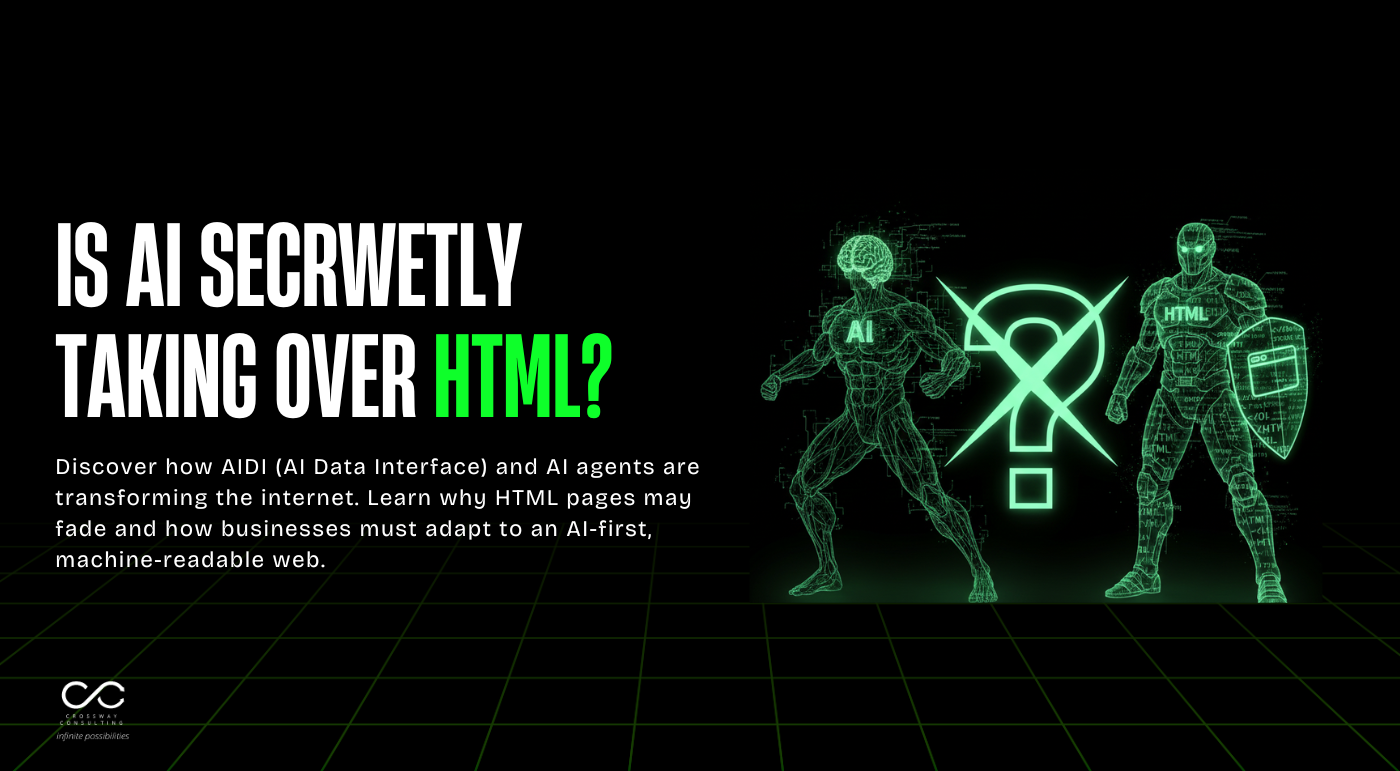
For nearly three decades, HTML has been the backbone of the web that enabled humans to browse, click, scroll, and consume information visually. However, rapid technological advancements have paved the way for the most disruptive era yet.
We have finally reached a distinctive phase in the technological evolution cycle, which many call the AI-first internet, marked by the rise of AI agents and personal AI assistants. As AI agents mature, we are likely to see extensions of existing standards like Schema.org optimised specifically for AI agent consumption that can be called AIDI or AI Data Interface.
This blog explores how AIDI and AI agents are dismantling traditional browsing behaviours, what it means for businesses and SEO, and how to prepare for a future where websites are built more for machines than humans.
The Shift From Human Browsing to AI-Powered Interactions
For years, the web structure was designed around a simple sequence:
User → Search Engine → Website → Action
Imagine you want to buy the best noise-cancelling headphones under $300. With the traditional web, your journey looks like this:
1. Searching Manually on Search Engines
You open Google and type: “best noise-cancelling headphones under 300. You get millions of results, and it’s for you to choose which ones to open.
2. Comparing Multiple Results
You click on 7–10 different websites, each offering answers to your query in different forms, like Tech blogs, YouTube reviews, retailer pages, or comparison articles.
Each website presents a list of “top picks,” the pros/cons of choosing specific models, and different affiliate links to relevant sites.
3. Reading Long Web Pages
Every website is likely to feature long-form content that may include any of the following types:
- 2,000-word buying guides
- Pop-up ads
- Affiliate disclosures
- Promotional content
On the website, you skim, scroll, and try to figure out what’s actually useful vs. what’s marketing fluff.
4. Clicking Links and Navigating Interfaces
Next, you open multiple tabs, linking you to different sites where you might make a purchase. Your search is likely to take you to e-commerce sites that specialise in selling headphones from a wide range of brands.
- Amazon
- Best Buy
- Walmart
- Brand websites (Sony, Bose, Sennheiser)
On any given site, you will come across numerous headphone options with a detailed description of factors, including prices, colours, warranty, shipping time, and availability
You bounce from one page to another to another to verify details that best match the image of your desired headphone.
From Browsing to Task-Based AI (The AIDI Revolution): How User Behaviour Is Changing in the Upcoming Years
This is a snapshot of what the old web experience looks like: a slow, manual process involving a sequence of repetitive steps that are heavily dependent on navigating HTML pages designed for human eyes.
The advent of AI agents has fundamentally altered user expectations and the traditional method of seeking out information. Instead of browsing, users increasingly issue commands or prompts to AI assistants;
- “Compare the best running shoes under $200 and pick one that fits my gait.”
- “Plan a 7-day budget trip to Turkey.”
- “Find me the top cloud HR software for my company size.
In other words, users are not making search queries based on keywords only, but ordering tasks that would lead them to the best possible option without much effort on their part.
Performing these tasks doesn’t require websites, but decisions made on behalf of humans, backed up by both rationale and human psychology.
Why AI Needs More Than HTML to Understand a Webpage? HTML is used to arrange text, images, and layouts so that browsers can display them to humans, which we know as website development. It basically determines where and how something appears when users interact with the web.
Let’s take the example of a simple restaurant website. When we humans see “Spicy Chicken Curry – $14.50”, we instantly understand that it is the name of the dish, while “$14.50” is the price of that product. Moving on, if we see something like “4.6 ★ (2,430 reviews),” we automatically know this is the restaurant’s rating, not a food quantity or a table number.
But none of this meaning exists inside the HTML code. HTML only decides how the text looks — bold, large, centred — not what the text actually represents.
| <div class=”menu-item”>
<span class=”dish”>Spicy Chicken Curry</span> – <span class=”amount”>$14.50</span> </div> <div class=”rating”>4.6 ★ (2,430 reviews)</div> <p>Chef: Andrew Martinez</p> |
As more machines began analysing websites — from Google to AI models — this became a real problem. How would a machine know that “4.6” is a rating and not a calorie count? Or how would it know that “$14.50” is a price and not the restaurant’s street address?
The Structured Data Solution With AI
Recognising these semantic deficiencies, the web community developed standards for embedding machine-readable metadata in webpages:
- Schema.org: A vocabulary for structured data supported by Google, Microsoft, Yahoo, and Yandex.
- JSON-LD: A format for linking data on the web
- Open Graph Protocol: Metadata tags for social sharing
- Microdata & RDFa: Alternative structured data formats
Using Schema markups on the website, our restaurant example could include:
| {
“@context”: “https://schema.org”, “@type”: “MenuItem”, “name”: “Spicy Chicken Curry”, “offers”: { “@type”: “Offer”, “price”: “14.50”, “priceCurrency”: “USD” }, “aggregateRating”: { “@type”: “AggregateRating”, “ratingValue”: “4.6”, “reviewCount”: “2430” } } |
Now machines know exactly what each value represents, which means no guesswork is required.
At the root of the problem is the fact that most websites don’t implement structured data consistently. It demands extra work, technical knowledge, and, until recently, offered limited SEO benefits. Although large platforms like Amazon and Yelp use it extensively, the average business website typically doesn’t.
What Is AIDI and Why Does It Matter?
AIDI or AI Data Interface refers to a standardised format that allows AI agents to access structured, machine-readable data. In simpler words:
AIDI can be understood as a universal language for machines that they use to communicate with websites, apps, and services. Instead of humans reading HTML via online searches, AI reads structured metadata, fields, and instructions. This enables AI agents to get direct access to exactly what you were seeking – an in-depth assessment of facts, features, and prices instantly to facilitate your decision.
AIDI Vs HTML Website Experience
Where HTML is designed for human eyes, AIDI is designed to equip machines with an understanding that drives actions and real-time decisions. This effectively means that you can bypass the typical hiccups over which you have little to no control.
- No ads
- No endless scrolling
- No pop-ups
- No affiliate-filled blogs
- No distracting UI
In reality, you get to the core of just pure data assembled and interpreted by an AI agent, who makes your work easier and faster than ever before.
This new machine-first internet means that traditional web design and text-heavy SEO content are fast becoming redundant as AI bots take charge of algorithms.
How AIDI OR AI Currently Handles Web Content
Modern AI systems employ two primary strategies for accessing web information:
1. Training Data
Today’s chatbots, including large language models like ChatGPT, generate responses based primarily on statistical word probabilities. They are trained on massive datasets including books, websites, articles, and more, and generate answers by predicting what sequence of words is most likely to follow a given prompt.
While this method works remarkably well for general conversation, it is not always accurate or reliable. If a fact is rare or poorly represented in the training data, the AI may hallucinate information, essentially making an educated guess. This is why AI responses sometimes contain inaccuracies, outdated information, or ambiguous interpretations.
2. Real-Time Retrieval (Dynamic Lookup)
One alternative approach is real-time retrieval, whereby AI first refers to external websites or databases before responding. This drastically improves accuracy by grounding answers in actual content. However, the AI is still required to interpret the raw HTML or text content, which has low semantic clarity.
For instance, if a webpage mentions “Mario Fischer,” the AI has to infer whether that name refers to an author, a business owner, or a character. Existing markup, like structured data, can help, but it is rarely implemented consistently across websites.
AI Data Interface (AIDI): Making Web Content Machine-Readable and Actionable
The ideal way to get around this dilemma is to provide information to AI in a fully structured, machine-readable format. The AI would no longer receive a wall of HTML text that needs to be parsed and stripped of styling, but rather a complete data structure resembling a database query result containing:
- Field labels (e.g., “Author,” “Price,” “Rating”)
- Field values (e.g., “Mario Fischer,” “$14.50,” “4.6 stars”)
- Additional metadata that attaches meaning to the content
When provided with such a structured form, AI can understand not only the values but also the underlying context and semantic relationships. The AI wouldn’t have to guess, infer, or rely on probabilistic reasoning so that it yields more accurate and actionable responses.
How APIs Inspire the Concept of AIDI
Industry observers are beginning to discuss what some call AI Data Interfaces or AIDI. AIDI’s work similarly to APIs work today — standardised interfaces that allow software systems to exchange data in a format that machines can understand directly. But an AI-first web calls for a dedicated interface optimised for AI-driven queries.
An AIDI would allow:
- Instant and precise access to data from multiple sources.
- Real-time updates without human interpretation delays.
- Seamless integration with AI agents that can take automated actions based on structured information.
- A foundation for entirely new types of AI-powered services, from personal shopping assistants to fully autonomous research bots.
In short, an AI-first interface like AIDI would transform the web from a human-readable environment into a machine-native ecosystem. It would eliminate much of the guesswork AI currently faces and open the door to a future where agents can perform complex tasks autonomously, using clear, unambiguous data.
The Rise of Silent Commerce
Conventionally, businesses have relied on traffic monetisation, where they draw their target users through transactional and informational searches on search engines that ultimately translate into revenue.
This was closely linked to a site’s position in search engine results pages, with over 96% clicks restricted to the top 10 results or the first page. As AI bots dominate search queries, users no longer have to spend time scrambling through vast text blocks on three, seven, or 20 websites to reach the information they need.
One of the biggest consequences of AIDI-driven AI agents is the explosion of silent commerce- a business model where purchases are made automatically by AI systems on behalf of users.
Here’s an overview of how this might work;
Suppose you want laundry detergent. You open Amazon, search, compare options, read reviews, and check out.
Here’s a scenario of a near-future possibility:
Your AI assistant detects you’re low on detergent from data analyzed through smart home sensors or purchase history, and helps you find the best deal that fits your preferences, be it eco-friendly or fragrance-free. Not only that, it is equipped to carry out the purchases automatically or send you a one-tap approval request.
What does this mean for Businesses?
Key considerations:
Trust barriers: Will consumers trust AI to make purchases unsupervised? This will probably only be for low-stakes, repeat purchases initially (groceries, household supplies, subscriptions).
Discovery vs. utility: Browsing is often part of the entertainment. People enjoy discovering new products, reading reviews, and comparing options. AI shortcuts work better for utility purchases than experiential ones.
Economic incentives: If AI agents make purchasing decisions, brands must compete for “AI attention” rather than human attention. Brands want their products and services to show up in AI responses rather than search queries.
The traditional buyer journey goes through the sales funnel, starting from awareness through consideration to the final purchase.
In contrast, the AI-mediated funnel would likely encompass these steps:
Query → AI Research → AI Recommendation → (Optional) Human Review → Purchase
In this model, businesses need to ensure:
- Their product data is machine-readable
- They appear in whatever sources AI systems trust
- Their value propositions are clearly structured and not buried in marketing copy.
How Businesses Should Prepare for an AI-First Internet?
If you want to prepare for increased AI-mediated interactions, here’s what to focus on:
1. Implement Structured Data (Start Today)
Use Schema markup to categorise your key content types:
- Products, if you’re an e-commerce
- Articles: If you publish content
- Local businesses, if you have physical locations
- Events, recipes, FAQs, etc.
Tools like Google’s Rich Results Test can help determine whether it’s successfully implemented or not.
2. Optimise for Featured Snippets and AI Overviews
When AI systems search for information, they often prefer content that directly answers questions instead of long, winding answers. Following the points below can help ensure your content is favoured by chatbots to appear in snippets and AI overviews.
- Use clear headings that align with commonly asked questions
- Provide concise, to-the-point answers early in the content
- Structure information in a logical flow by including tables, lists, and comparisons
3. Consider API-First Architecture
If you’re building new software systems from scratch, prioritise key functionality through APIs that both your website and external AI agents could consume.
4. Monitor AI-Driven Traffic
As AI engines become the norm, business focus would shift from acquiring traffic organically towards referral traffic from AI platforms:
- ChatGPT (via browsing feature)
- Perplexity
- Google’s AI Overviews
- Microsoft Copilot
Understanding how AI systems discover and utilise your content helps you optimize for them.
5. Maintain Content Quality and Authority
AI systems increasingly factor in content quality, author expertise, and site authority when deciding what to recommend. Simply put, the fundamentals of good content haven’t changed- it’s just how it’s discovered.
Critical Challenges
While the potential of AI-mediated commerce is compelling, we can’t brush aside several critical concerns.
1. The Hallucination Problem
Despite their highly sophisticated algorithms, AI systems can generate false or misleading information with complete confidence. In contrast, users can verify claims, read reviews, cross-reference information, and browse websites themselves.
When an AI agent does this on their behalf, that verification layer disappears—unless specifically designed into the system.
The Loss of Control
For decades, businesses have carefully controlled how they’re presented to customers through website design, marketing copy, and brand guidelines. AI agents threaten to upend this entirely.
When an AI agent describes your product, it synthesises information from reviews, specifications, competitor comparisons, and its training data. For example. Your company may position itself as a “premium, artisanal coffee roaster but AI might describe you as “a mid-priced coffee brand with decent reviews”.
The Conflict Problem
Users increasingly rely on AI for decision-making, but what happens when different AI platforms give conflicting recommendations? For instance, ChatGPT recommends Product A based on technical specifications and expert reviews, whereas Google’s AI Overview suggests Product B based on aggregate ratings and pricing.
The Concentration of Power
Today, Google dominates search with roughly 90% market share, but at least with search, users see multiple results and choose which to visit. With AI agents, users often receive a single recommendation or a narrow set of options curated by the AI.
If 70-80% of users rely on ChatGPT, Google’s AI, or Amazon’s Alexa for purchase decisions, these platforms become unprecedented gatekeepers. Being excluded from their recommendations could be commercially devastating.
Will Websites Become Obsolete?
The short answer is it’s far too early to rule out websites entirely. As long as the web exists, it’s far more likely that it’ll evolve to keep pace with the requirements of an AI-powered world. Some compelling reasons why human-facing websites will persist include:
- Brand experience: Companies invest in websites to create emotional connections, tell stories, and build brand identity. An API response can’t replicate that.
- Discovery and browsing: Not all web sessions are goal-oriented or transactional. People browse for a multitude of reasons, like inspiration, entertainment, or simply random searches.
- Complex decisions: When it comes to high-stakes purchases like houses, cars, and medical procedures, humans instinctively rely on what they see and prefer to retain control over outcomes.
- Trust and verification: There still exists a degree of skepticism about the authenticity of AI responses, which can compel users to visit the source directly.
- Legal and regulatory: Many industries are governed by disclosure requirements that necessitate human-readable interfaces.
The Likely Future: Hybrid Approach
Smart businesses will maintain:
- Human-facing interfaces: User-friendly, branded websites to help users discover them, make decisions, and build brand awareness.
- Machine-readable data: Structured data, APIs, or AI-optimised interfaces for agent-mediated interactions
This mirrors how businesses today maintain both websites and mobile apps, which serve the same core functionality but deploy different interfaces for different contexts.
Conclusion:
Ten years from now, we might look back at 2025 as the year the internet fundamentally changed —not with a bang, but with a whisper. AI agents are working quietly in the background, making our lives easier while reshaping the entire digital economy.
The transition to an AI-mediated internet won’t happen overnight, but the shifts are already underway. The businesses that thrive will be those that act strategically—starting now with foundational changes while remaining adaptable as the landscape evolves.
The AI-first internet isn’t replacing the web you know—it’s adding a new layer. Your goal isn’t to abandon what works, but to become fluent in both human and machine communication.
The real question isn’t whether AI will change how users discover your business. It’s whether you’ll be ready when they do.