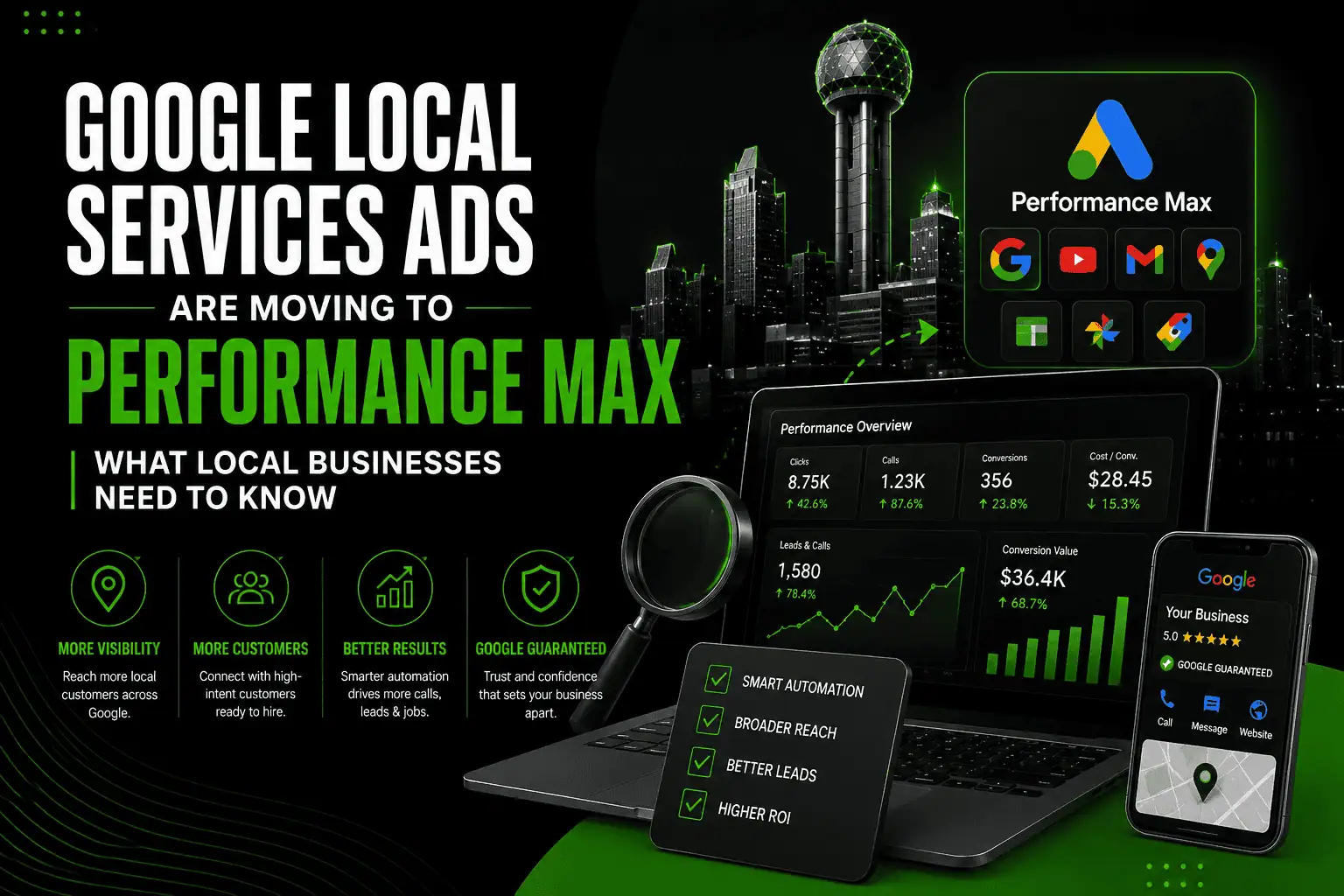
If your business runs Local Services Ads the pay-per-lead listings that show up at the very top of Google Search for home services, legal, and other local trades a significant platform change is already underway. Starting in August 2026, Google began migrating existing LSA campaigns into the main Google Ads platform as a new, specialized Performance Max campaign type built for pay-per-lead goals.
This isn’t a minor interface update. It changes how you manage bidding, where your reporting lives, and what historical data you’ll have access to. Here’s what’s actually changing, based on Google’s own Ads Help Center documentation, and what to do before your account migrates.
Why Google Is Making This Change
Google’s own documentation frames this as a move toward a more integrated, self-service experience: rather than managing Local Services Ads in one dashboard and every other Google campaign in a separate Google Ads account, advertisers will handle all of it in one place. For businesses that run LSAs alongside Search or Performance Max campaigns already, that consolidation is a genuine simplification one login, one billing relationship, one place to check performance across every campaign type.
The tradeoff is that LSAs lose some of the standalone characteristics that made the product easy to reason about on its own. Manual bidding and vertical-specific cost targets tools that gave advertisers direct, predictable control are being replaced by Google Ads’ automated bidding systems, which optimize continuously based on signals Google decides are relevant. That’s consistent with the direction Google Ads has been moving generally: fewer manual levers, more automated decision-making, and a greater premium on the quality of the data advertisers feed the system.
What’s Changing
The dashboard is going away. The standalone Local Services Ads dashboard is being retired. Campaign management, budgets, targeting, and lead responses move into the main Google Ads interface alongside the rest of your campaigns.
Manual bidding is being phased out. If you’ve been setting your own max cost-per-lead, that control is being deprecated in favor of Google Ads’ automated bidding configurations. Vertical-level Target CPA is also going away.
Weekly budgets convert to daily or monthly. This is a structural change to how you’ll plan and pace spend.
Historical performance reports do not migrate. This is the detail most worth acting on now. Google has been explicit that while lead histories transfer into the new Lead Manager tab, your historical performance reports the data you’d use for year-over-year comparisons or client reporting — will not carry over automatically. You need to export what you need before your account migrates.
BBB callouts are being removed. If you’ve relied on Better Business Bureau callouts to signal credibility, you’ll need to replace them with structured callouts inside Google Ads (payment methods, hours, specialties, etc.).
What’s Staying the Same
Google has been consistent on this point across its own documentation and public statements: the customer-facing experience isn’t changing. You’ll still pay only for valid leads under the pay-per-lead model, not clicks. Ads will still appear exclusively at the top of Google Search and on Google Maps, in the same positions LSAs have occupied. Targeting stays keywordless, based on your service categories and geographic area rather than manual keyword lists. And Google Guaranteed / Google Screened eligibility carries through the migration.
In other words: despite the “Performance Max” name, this isn’t turning your LSA campaign into a broad, cross-network campaign running across YouTube, Display, Gmail, and Discover. It’s a specialized Performance Max variant built specifically to preserve the LSA experience while consolidating account management.
Local Services Ads Performance Max Migration Timeline
Google’s rollout is phased, not immediate:
- August 2026: The first phase began with a limited group of U.S. advertisers in home and storefront service categories plumbing, HVAC, electrical, appliance repair, house cleaning, lawn care, roofing, pest control, and moving, among others.
- Late 2026: The migration expands to broader advertiser groups, including service-area businesses without a physical storefront and accounts running custom bidding or booking configurations.
- 2027: Non-U.S. advertisers begin migrating.
Account administrators receive an advance email notification 14 days before their scheduled migration date, with a reminder seven days later, and confirmation once the migration completes.
What to Do Before Your Account Migrates
Export your historical reporting now don’t wait for the notification. Once your account migrates, the original LSA dashboard becomes inaccessible and past performance reports won’t be there. If you need year-over-year data, client reports, or internal benchmarks, download them while you still have access, especially if your migration date isn’t yet on the calendar.
Build a measurement baseline before the change hits. This matters for a reason that goes beyond simple record-keeping. As Search Engine Journal noted in its coverage of Google Ads’ broader automation push, when a platform takes over more of the bidding and targeting decisions, a shift in reported cost-per-lead or lead volume after a change like this doesn’t tell you on its own whether the change was good or bad you need to know whether lead quality moved in the same direction. Capture your current numbers before migration: cost per lead, lead volume, qualified-lead rate if you track it, and how many leads actually convert into booked jobs or closed business. That baseline is what lets you tell the difference between normal week-to-week fluctuation and a real change in results once your account moves.
Set up structured callouts to replace BBB callouts. If your ads currently lean on BBB accreditation to build trust, decide now what will replace that signal licensing details, years in business, guarantees, or other structured callouts Google Ads supports.
Review your budget structure. If you’ve been managing spend on a weekly cadence, plan how that maps to daily or monthly budgeting before the conversion happens automatically.
If you run separate bidding by service category, plan for separate campaigns. Vertical-level Target CPA is being deprecated, so if you currently rely on different cost targets for, say, plumbing versus HVAC leads within one account, you’ll likely need separate campaigns per vertical to preserve that distinction post-migration.
This is also a reasonable moment to audit the account beyond just the migration checklist automated bidding transitions are when common PPC mistakes (misaligned conversion goals, missing negative keywords, stale asset groups) tend to get inherited into the new campaign structure rather than caught and fixed.
For Agencies and Multi-Location Businesses
If you manage LSA campaigns for multiple clients or multiple business locations, the export step above isn’t optional it’s the difference between having a clean before-and-after comparison for every account and losing that ability the moment each one migrates. Migration dates are staggered per account, not account-wide for an agency’s full client roster, so a practical approach is to build a standing checklist (export reporting, confirm callout replacements, verify budget conversion) that gets run the moment each 14-day advance notice arrives, rather than trying to remember to do it manually for dozens of accounts on different timelines.
It’s also worth flagging the change to clients proactively rather than waiting for them to notice a dashboard has disappeared. Even though Google frames this as primarily a backend and management change, a client who logs into a bookmarked LSA dashboard and finds it gone with no context reasonably assumes something has broken.
Common Questions
Do I need to do anything if I don’t currently use manual bidding or vertical-level Target CPA? The migration still affects you your dashboard moves, budgets convert from weekly to daily/monthly, and historical reports don’t carry over regardless of which bidding strategy you were using. The export step matters for every LSA advertiser, not just those on manual bidding.
Will my cost per lead change after migration? Google has not published guidance promising costs will stay flat, and given that automated bidding is replacing manual cost controls, some fluctuation should be expected. This is exactly why a pre-migration baseline matters it’s the only way to tell whether a change in cost per lead reflects a real shift or normal variability.
Does this affect Google Guaranteed or Google Screened status? No Google’s documentation confirms that eligibility for these programs carries through the migration unchanged.
When will my account migrate? Google is rolling this out in phases through 2027, starting with a limited set of U.S. home and storefront service categories in August 2026. You’ll receive a 14-day advance notice by email once your account is scheduled.
The Bigger Picture
This migration is part of a broader pattern in how Google Ads operates in 2026: more of the day-to-day mechanics bidding, budget pacing, campaign structure move under automated management, and the manual levers advertisers used to rely on go away. That doesn’t mean less oversight is required; it means the oversight shifts. Instead of adjusting bids campaign by campaign, the more valuable work becomes making sure Google has accurate signals to optimize against and knowing what your actual business outcomes look like well enough to catch it if something changes for the worse.
For local service businesses, that means the LSA-to-Performance-Max migration isn’t just a platform update to click through it’s worth a deliberate before-and-after comparison, backed by data you preserved ahead of time.