The arena of digital marketing is highly dynamic, with brands and websites vying in a relentless battle for visibility. One prominent debate raging on for years is “SEO vs PPC” as businesses try to figure out which works best for them.
SEO and PPC are two central digital marketing strategies that help draw more visitors to your site and, hence, build a lasting online presence. While SEO leverages organic search results to boost visibility, PPC relies on paid ads to put you right in front of the customer and generate instant leads.
In this guide, we explore the essentials of the SEO vs. PPC debate, highlight their pros and cons, and help you invest in the right channel for your business.
The Old Debate: Seo Vs. PPC
What IS PPC?
PPC stands for ‘pay per click’ and is a search engine marketing strategy in which advertisers pay whenever a user clicks their ad. One popular example of PPC is the sponsored ads that feature right above the search results.
It is based on a straightforward rationale; you don’t have to pay if no clicks are generated, which makes it a viable option to drive clicks while keeping costs under control. In other words, you only pay when there is actual engagement, but there is a trade-off.
It depends on a continuous stream of investment, as PPC costs change constantly with thousands of bids occurring each second. The competition is especially pronounced during peak business seasons, holidays, or special events.
What is SEO?
SEO stands for ‘search engine optimisation’, and is the practice of getting a website to rank higher in search engine results. It deploys on-page optimization tactics like strategic keyword placement, meta tags, and alt images, internal and external linking, along with SEO-friendly content. It also involves technical SEO to structure your site’s architecture for fast loading and crawlability, helping search engines index web pages.
The higher you rank in search results, the greater the visibility, which makes your site discoverable to more people. Unlike PPC, SEO helps improve your position in search engine results, bringing clicks organically without paying for them.
SEO can be a make-or-break factor in your web presence, but it’s a long-term strategy that demands continuous monitoring and measurement of key metrics.
Timeline: How Fast Do You See Results?
Choosing between SEO and PPC isn’t as much about which is “better” as it is about which fuel your business needs right now.
SEO Timeline
SEO is a long-term strategy, meaning it takes a certain amount of time before you hit momentum and search rankings spiral upwards. According to a Google expert, SEO needs a minimum of four months to a year to register improvements in rankings and reap measurable results for your business.
After setting up your first campaign, you can start seeing traction within the first three months as SEO builds your online presence and visitors discover your site. It all depends on where your website is at the start of implementation. If you just acquired a brand-new domain, your SEO growth will occur rather slowly because you are pitted against more established sites with a strong footing in the search landscape.
However, it’s only after 3-6 months that the rankings reasonably improve for you to notice as your site moves to page 2. Here, the Google Sandbox effect also comes into play, where Google spends the first few months simply verifying that your site is a legitimate, long-term player and not a spam site.
This can eventually extend to 12 months for traffic to compound, particularly in competitive industries. This is when your business makes it to the top 3 search results, eventually reflected in your ROI as a sign that your seo investment is paying off.
What Speeds (or Slows) Your SEO Results
Apart from the age of your website, other factors influencing SEO results are how quickly SEO changes are implemented and the time search engines take to assess and crawl updated pages.
The Developer Queue
SEO is only as fast as your dev queue. Plainly speaking, if the developers take weeks or months to fix errors and implement relevant changes as per Google’s core algorithm updates, search visibility will take longer to improve.
Site Architecture & JavaScript
Google also has its own timeline for assessing changes and crawling updated pages based on your site’s authority, size, and architecture. Sites relying heavily on client-side JavaScript can face significant delays in indexing, as Google must often queue these pages for a second rendering pass. This can make the ‘discovery-to-ranking’ window significantly longer than that of a lightweight, HTML-first site.
Crawl Frequency & Authority
Finally, your site’s authority determines how often Google even shows up. This is where high-quality backlinks act as a speed boost; the more authoritative your domain, the more frequently Google’s “spiders” visit to discover, assess, and rank your updated content.
PPC Timeline
PPC is immediate, which means it’s only a matter of hours for your name to pop up at the top of Google’s results. Although PPC can be dramatically fast compared to SEO, it goes through a learning curve in the first 30 days of your campaign, as data matures over time.
Here is how a PPC timeline actually unfolds for a business:
- Day 1: Your ads go live the moment your bid is approved. PPC can be thought of as rented real estate, where you earn a premium spot in search results without having to climb up the ladder of rankings, as in the case of SEO.
- Week 1: By the end of the first week, you’re not merely getting traffic but valuable, real-time intelligence. This allows you to determine which headlines get the highest share of clicks and, more importantly, which keywords are “tire kickers” versus “buyers.”
- Month 1: Your PPC campaign enters the optimization phase, where your efficiency is at its peak. You can finally get rid of keywords, low-performing hours, or locations that are draining your ad budget and direct it towards those the most lucrative for your business.
The amount of data you gather as your campaign progresses can help you calculate your Cost Per Lead (CPL). This metric helps you know exactly where your marketing budget is actually working to help you, prospective customers.
Cost Comparison: SEO vs PPC
When you break down the numbers, the “SEO vs. PPC” debate isn’t just about how much you spend but also about where that money goes.
The Pillars of an SEO Investment
Unlike PPC, where you pay for the result (the click), with SEO, you are paying for the infrastructure. Your monthly investment covers three distinct areas:
- Content Creation: This includes crafting a variety of content like high-authority articles, technical guides, and landing pages that Google identifies as helpful.
- Technical Optimization: It ensures your site is fast, mobile-responsive, and uses modern Schema markup so AI search engines can “read” your data.
- Ongoing Strategy & Backlinks: This is the “navigation” part. It involves monitoring algorithm updates and building the digital “votes of confidence” (backlinks) that tell Google you are a local leader.
| Tier | Monthly Investment | What’s Typically Included | Best For |
| Starter | $500 – $1,500 | Basic on-page SEO, keyword research, monthly reporting, and minor technical fixes | Small businesses, local SEO, tight budgets |
| Growth | $1,500 – $5,000 | On-page + off-page SEO, content creation (2–4 posts/month), link building, technical audits | SMBs looking to scale organic traffic |
| Professional | $5,000 – $10,000 | Full content strategy, authority link building, CRO, competitor analysis, dedicated account manager | Established businesses in competitive niches |
| Enterprise | $10,000 –$25,000+ | Multi-location or multi-site SEO, advanced technical SEO, PR-driven link building, and custom reporting | Large brands, e-commerce, national/global campaigns |
Let’s break the “Zero Cost” Illusion. It is common to hear that organic traffic is “free.” In reality, you don’t pay Google for the click, but the traffic is actually prepaid. A simple math will make thsi clearer.
If your monthly SEO investment totals $3,000 and generates 3,000 visitors, your “effective CPC” is $1.00. Assuming that the content continues to rank next year without additional spend, your effective CPC drops toward $0.
The Mechanics of the PPC Auction
PPC pricing isn’t arbitrary but a calculated “bid” based on three core pillars:
- Cost Per Click (CPC): The amount you pay every time someone interacts with your ad. This is the “unit price” of your traffic.
- Competition: In a crowded market, the “entry fee” to appear on Page 1 is way higher. If five other agencies are bidding on “Reef tank maintenance,” the price for that click will soar.
- Industry & Intent: Keywords that signal a high “likelihood to buy” (e.g., “emergency diesel repair near me”) always command a premium over research-based terms (e.g., “how does a turbocharger work”).
| Competition Level | Typical CPC | Industry Examples |
| Low | $1 – $5 | Local hobby shops, niche blogs, low-intent brand terms. |
| Medium | $5 – $15 | General home services, e-commerce, and automotive maintenance. |
| High | $20 – $100+ | Legal services, SaaS, Insurance, and Specialized Logistics. |
The most important distinction in PPC budgeting is that you pay for every visitor. If you want to scale it to 1000 visitors with a CPC of $5, you must spend $5,000, as higher volumes don’t bring discounts.
If your landing page is slow or your offer is weak, you still pay for that click. This is why “Negative Keyword” lists and high Quality Scores are the only way to protect your margins.
When Should You Choose PPC?
If you are launching a new product, running a seasonal promotion, or need to fill a service gap this week, PPC is your only move. Once you launch your PPC campaigns into action, you get a steady flow of leads, but that stops the moment you stop bidding. PPC is ideal for:
- Immediate Lead Gen: High-intent terms like “emergency reef tank repair” or “towing service near me.”
- A/B Testing: Quickly seeing which headlines or offers resonate before committing to a 6-month SEO content plan.
When Should You Choose SEO?
SEO is the better choice if:
- You desire long-term growth and build a dedicated traffic flow so that users keep coming back to you.
- You have time (3–6+ months) to wait for SEO to yield measurable results.
- You’re building authority in your industry.
- You want a lower cost per lead over time. This gives businesses the flexibility to adjust their budget and gain clicks naturally.
SEO vs PPC: Which Is Better?
There is no universally right answer to this question, as each strategy uses distinct methods to achieve the ultimate goal: visibility. When it comes to choosing between the two, the decisive factor is the objectives you are pursuing.
If you are looking at brand visibility and sustained online success, SEO services are a worthwhile investment that can help build your business on a robust digital foundation. If you are leading a time-limited campaign and expect quick gains, PPC is your best bet.
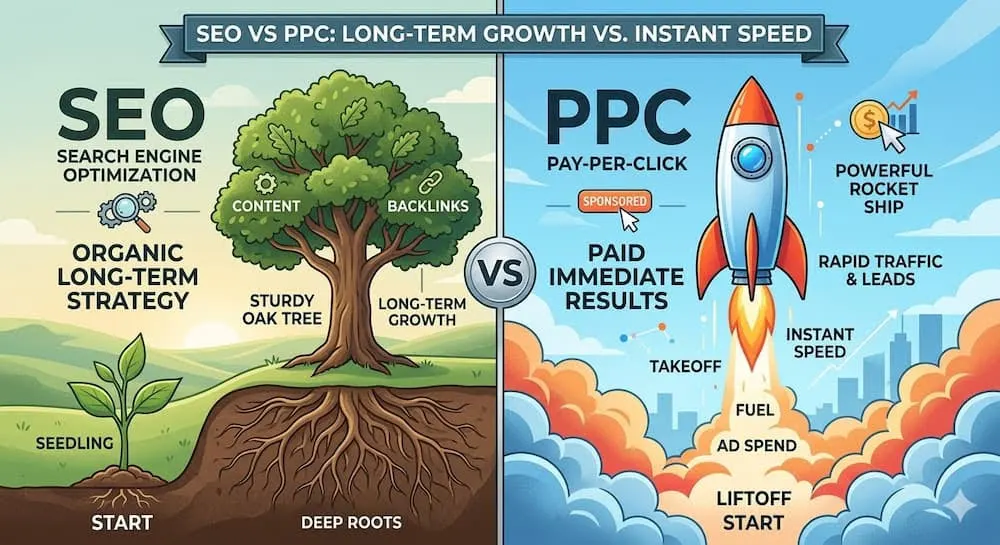
You can think of the two strategies as different types of “velocity”. With PPC, you go from 0 to 100 instantly, but you stay at a flat plateau relative to your spend. SEO is more like an exponential Curve that starts at 0 and stays near 0 for a while, but once it “breaks out,” the growth curve steepens sharply without incurring extra cost.
Example ROI scenario:
- SEO: $3k → 3k traffic → $1 CPC equivalent
- PPC: $5 CPC → $5k for 1k visitors
The Smart Strategy: Blend of SEO and PPC
It’s clear that each strategy comes with specific advantages, but the highest-performing teams don’t treat it as an either-or choice. They prefer an integrated approach that blends the benefits into one cohesive strategy to maximize results. This offers an opportunity to maximize visibility by showing up in both paid and organic results, a powerful advantage in a saturated digital space.
For instance, data from PPC campaigns can reveal valuable keyword intelligence to help optimize your SEO strategy. The rapid response of PPC provides an open territory to test new offers, launch landing pages, and identify high-converting keywords.
Assume a specific long-tail keyword, say, “heavy-duty DEF system repair in Arlington,” has a 15% conversion rate in your Google Ads. You can exploit this keyword to create a dedicated content cluster that improves your ranking potential and allows you to capture more clicks.
Tapping into both simultaneously can give you an overview of the various stages of your user journey from research to final purchase. While PPC helps you capture high-cost, hyper-competitive “vanity” terms, your SEO strategy can cover technical, educational content that attracts users at the top of the funnel.
SEO data, like high-performing organic landing pages, improves Quality Score, which directly lowers your PPC costs. The combined effect of both strategies ensures that your brand emerges as the logical solution for customers, whether they are seeking out a quick fix or a long-term partner.
When SEO and PPC stop competing for the same budget and start sharing the same data, the efficiency gains multiply. As you establish organic authority for specific keywords, you can pivot your PPC spend toward untapped territories or hyper-competitive ‘conquest’ terms. Occupying both the sponsored ‘Position 0’ and the #1 organic spot creates a psychological ‘halo effect’, positioning your brand as the undeniable market leader in the eyes of the customer.
Conclusion
The above information will help you resolve the dilemma of the SEO and PPC debate. It’s for you to decide which is right for your business based on how far you are willing to stretch your budget, the growth phase you are in now, and what you expect to achieve in the short or long-term.
If you’re deciding where to invest your marketing budget, getting the strategy right upfront can save you thousands. The Bottom Line is simple: SEO builds your future while PPC fuels your present. The businesses that win don’t choose between them but integrate them intelligently.
Ready to Own the Search Results?
Whether you’re looking to dominate the local market, scale a specialized service, or broaden your reach, a consistent approach can make all the difference.
At Crossway Consulting, we help businesses build balanced growth strategies by combining SEO and PPC in a way that maximizes ROI, not just traffic.
Contact us today for a custom search Audit and see how a unified SEO + PPC strategy can transform your bottom line.
FAQ’s
Is SEO better than PPC for small businesses?
SEO is better as a long-term strategy for building organic visibility, boosting site authority, and maximizing your ROI without continuous spending. PPC helps generate immediate leads by attracting attention through top placement in paid search result but it is a recurring expense
Can SEO and PPC work together?
Yes. Integrating them can amplify your digital marketing initiatives and help you increase visibility on paid and organic search results. While PPC provides data to identify keywords with a high conversion rate, SEO can position sustainable growth.
Which is cheaper: SEO or PPC?
SEO is generally cheaper over time as it builds long-term visibility that draws sustainable traffic and ultimately ROI without additional spending. PPC is more expensive and requires continuous bidding for every click you generate.